
When I was working out how the kit should be assembled, I kept asking the wrong question.
The right question wasn’t: how do we make this easy to build? It was: what needs to happen inside a person for them to enter a quiet, focused state — and stay there long enough to finish?
That reframing changed almost every decision.
The first problem was fear.
Not the dramatic kind. The small, domestic kind that stops people before they begin. The feeling that if something goes wrong, it can’t be undone. That there is a correct version of this, and you might ruin it.
This is what adhesive does to a making experience. Glue implies permanence. Once something is fixed, it is fixed. The person holding the brush becomes careful in a way that is not concentration — it is closer to anxiety. The body tenses. The breath shortens. Whatever openness the hands might have had closes down.
I removed the glue entirely. Not to simplify the process. To remove the feeling of one-way commitment.
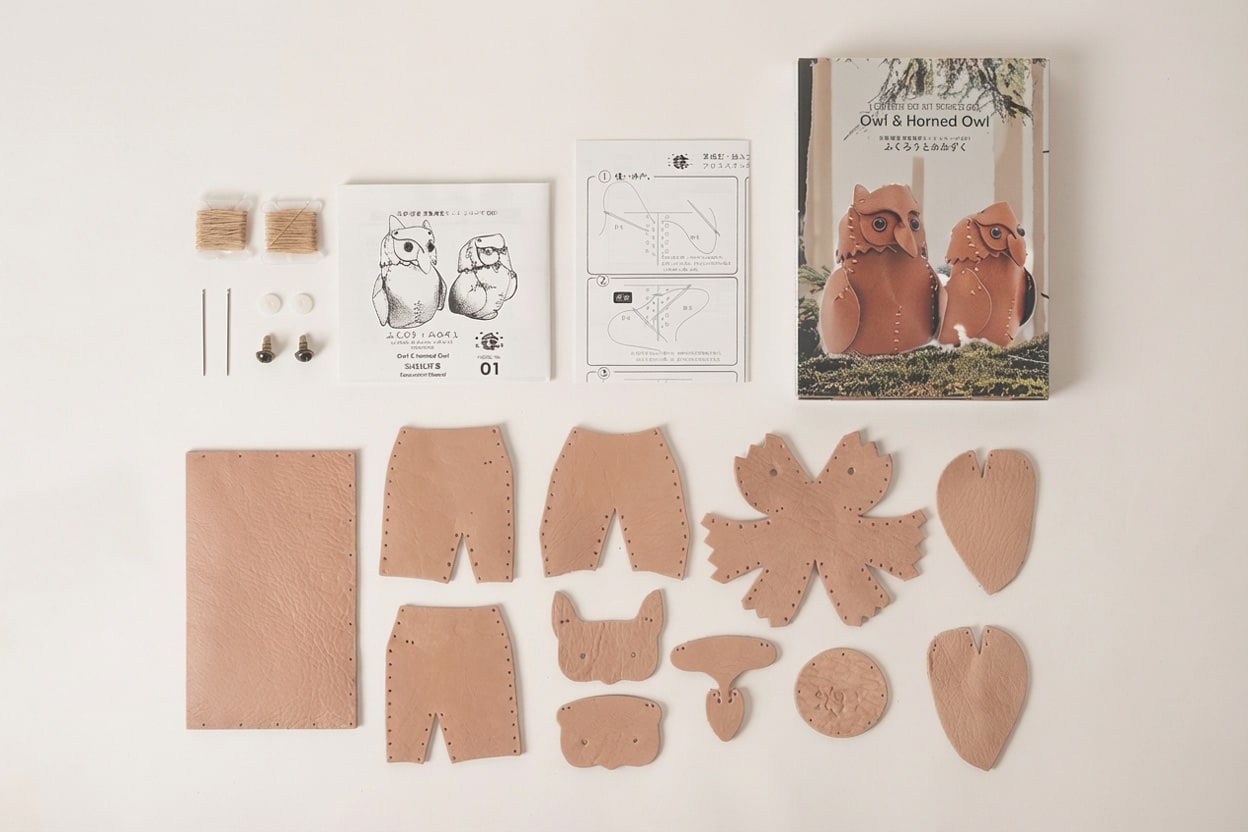
The holes in the leather parts are pre-cut. This also looks like a convenience, and it is — but that’s not why it’s there.
If a person has to punch their own holes, they enter a different mode. They think about precision. They worry about placement. They pick up a tool and feel, suddenly, that some competence is required of them. The experience shifts from contact to performance.
I wanted the hands to go directly to the leather. To feel the surface, the weight, the slight give. Not to demonstrate ability. The holes are pre-cut so that the first thing a person touches is the material itself, not a task.
Sewing could have been replaced. Buttons, press-fit connections, small magnets — any of these would have held the parts together. Several would have been faster.
I kept the sewing.
There is something that happens when you pull a waxed thread through leather, repeatedly, in the same motion. It is not complicated, but it requires the whole hand. The thread catches slightly — not enough to resist, just enough to register. There is a small rhythm that develops. The breath follows it. The mind, which had been moving at the speed of everything else in the day, begins to slow to the speed of the hands.
That slowing is the product. Everything else is a container for it.
So I kept the sewing. It is the part of the kit that most directly creates the state I was designing toward.
The assembly time — roughly thirty to ninety minutes depending on the model — is not incidental. Too short, and the absorption hasn’t fully begun before it ends. Too long, and the experience tips from focus into fatigue. The window I was looking for was the one where a person could feel genuinely removed from everything else, without feeling exhausted by the removal.
I made a number of prototypes before this felt right. It is a narrow band.
There was one more thing I spent a long time on, which is harder to describe technically. It has to do with what the finished object becomes.
Leather is a flat material. It arrives in the kit as flat parts. By the end, it has become a three-dimensional form that stands on its own, holds its shape, casts a shadow. That transformation matters — not as a craft achievement, but because the object needs to exist quietly in a room after it has been made. Not displayed. Not explained. Just present.
I adjusted the curves, the proportions, the silhouette over many versions. What I was calibrating for was not cuteness. In fact I was deliberately moving away from that — from the mascot quality, the performed charm. What I wanted was something with a small, contained presence. The kind of thing you don’t notice every day, but would notice if it disappeared.
If it reads as a character, the time inside it gets forgotten. If it reads as a presence, the time remains.
Every structural decision in the kit points in the same direction: toward a state of quiet attention, entered without fear, sustained through the body, and left behind in the form of something that continues to exist in the room.
That was the brief. Assembly instructions were secondary.
Muneshige Tanigawa / Kyoto Makotoya
キットの組み立て方を考えていたとき、ずっと間違った問いを立てていた。
正しい問いは「どうすれば簡単に作れるか」ではなかった。
「人が静かな集中状態に入るために、何が必要か。そしてその状態を、完成まで保つには」だった。
その問いに変えた瞬間、ほぼすべての設計判断が変わった。
最初の問題は、恐怖だった。
劇的なものではない。小さな、日常的な恐怖。
何かがうまくいかなかったとき、取り返しがつかないかもしれないという感覚。
「正しい完成形がある、そしてそれを壊すかもしれない」という感覚。
接着剤は、その恐怖を作る。
接着剤は不可逆を意味する。一度固まれば、そこで終わる。
筆を持つ人は、緊張するようになる。集中とは違う何かで。不安に近いもので。
身体が固まる。呼吸が浅くなる。
手が開こうとしていたのに、閉じてしまう。
だから接着剤をなくした。
簡単にするためではない。
「一方通行の感覚」を取り除くために。
革のパーツに穴が開いている。これも便利さに見えるが、それが目的ではない。
自分で穴を開ける構造だと、人は別のモードに入る。
精度を考える。位置を心配する。
工具を持った瞬間に、何かの技術が自分に求められていると感じる。
体験が「接触」から「実演」に変わる。
手を最初から革へ向かわせたかった。
表面を感じる。重さを感じる。少しのしなりを感じる。
能力を示すためではなく。
だから最初から穴が開いている。最初に触れるのが素材そのものになるように。
縫うことは、別の方法に替えられた。
ボタン、はめ込み、マグネット。
どれでもパーツは繋がる。いくつかはもっと速い。
でも縫うことを残した。
ロウびきの糸を革に通す動作を繰り返すとき、何かが起きる。
難しくはない。でも手全体を使う。
糸が少し引っかかる。抵抗するほどではない。ただ、そこにあると感じられるくらい。
小さなリズムが生まれる。呼吸がそれに従う。
一日の速度で動いていた頭が、手の速度に合わせ始める。
その減速が、プロダクトだった。
他のすべては、それを入れる器だった。
だから縫うことを残した。
キットの中で、設計していた状態に最も直接的につながる部分だから。
組み立て時間は、モデルによって30分から90分ほど。これも偶然ではない。
短すぎると、没入が始まる前に終わる。
長すぎると、集中が疲労に変わる。
探していたのは、日常から本当に切り離されながら、消耗せずに戻ってこられる時間の幅だった。
その感触が掴めるまで、いくつものプロトタイプを作った。
かなり狭い帯域だった。
技術的に説明しにくい、もう一つのことがある。
完成した後、そのものが何になるか、という話だ。
革は平面素材だ。キットの中でも平らなパーツとして届く。
完成すると、自立する立体になる。形を保ち、影を落とす。
その変化が大事なのは、クラフトとしての達成感のためではない。
作られた後、そのものが部屋の中に静かに存在できるかどうか、を最初から重視していたから。
カーブ、比率、シルエットを何度も調整した。
目指していたのは可愛さではなかった。むしろ意図的に避けていた。
マスコットの感じ、作られた愛嬌。そういう方向から離れていた。
欲しかったのは、小さく、静かな存在感。
毎日は気にならないけれど、なくなったら気づく、そういうもの。
キャラクターとして読まれると、作っていた時間が忘れられる。
気配として読まれると、時間が残る。
キットのすべての構造的な判断は、同じ方向を向いている。
恐怖なく入れて、身体を通じて続く、静かな集中の状態へ。
そしてその時間が、部屋の中に形として残り続けるために。
それが設計の目的だった。
組み立て説明書は、その次の話だった。