
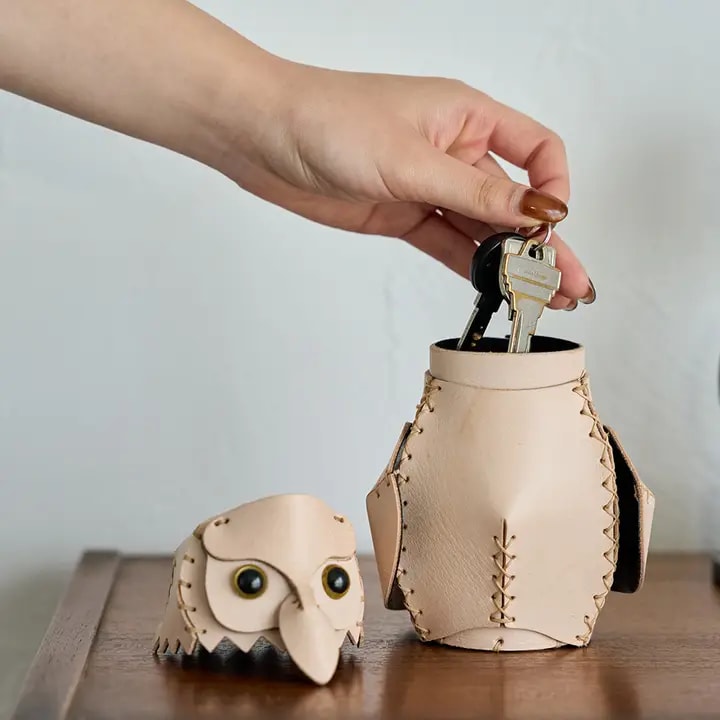
When I was deciding what the first kit would be, I kept returning to the same question: what kind of presence did I want in a room?
Not a character. Not something with personality that announced itself. Something that stayed.
I had been thinking about this for a while — the difference between objects that demand your attention and objects that simply exist alongside you. Most things now demand. They are designed to pull your eye, to signal something, to perform. I wanted something that didn’t.
The owl came to me not as an idea but as an image. Still. Watching. A little apart from the surrounding noise.
Owls don’t belong to the day. They belong to the hours when things get quieter — when the light changes and the room settles and you can finally hear yourself think. That felt right for what I was trying to make. Something for the slower hours. Something for when you’ve set down your phone and your hands don’t quite know what to do with themselves.
There’s something in Japanese about owls that I find useful. Fukuro — the word carries fuku, fortune, folded inside it. But it isn’t the loud fortune of the beckoning cat, the waving paw, the bright red. It’s something more private. Closer to a standing wish than a proclamation. That’s the kind of luck I was interested in — the kind you keep to yourself, the kind that doesn’t require an audience.
I didn’t want to make lucky charms. I wanted to make objects that held a small, private intention.
The difference, I think, is this: a lucky charm is given its meaning before it reaches you. A completed owl — one you stitched together yourself, one thread at a time, slowly, over an evening — means something because of the time you put into it. You paid for whatever it carries. You earned the right to believe in it a little.
When I picture the finished owl sitting somewhere — on a desk, near a window, just within your field of vision — I want it to be the kind of thing you don’t notice every day, but that you’d notice if it were gone. That’s the presence I was trying to design. Not decorative. Not useful, exactly. Just quietly there. A small shape in the corner of a room that remembers the hour you made it.
That’s where Kyoto Makotoya begins. With an owl, watching. Not saying much.
Muneshige Tanigawa / Kyoto Makotoya
フクロウから始まった。
最初のキットを何にするか決めるとき、ずっと同じ問いに戻っていた。 部屋の中に、どんな気配を置きたいのか。
キャラクターではなく。自己主張するものでもなく。 ただそこに在るもの。
フクロウが浮かんだのは、アイデアとしてではなく、一つのイメージとしてだった。 静かに、見ている。喧騒から少し離れた場所に。
フクロウは昼の生き物ではない。 光が落ちて、部屋が静まり、ようやく自分の声が聞こえてくる時間に属している。 それが、自分が作ろうとしているものに合っていた。 もう少しゆっくりした時間のためのもの。 スマホを置いて、手が行き場をなくしているような時間のためのもの。
「フクロウ」という言葉には「福」が入っている。 でも招き猫のような、派手な福ではない。 もっと内側の、静かな祈りに近い。 大きな声で言うより、心の中でそっと持っているような種類の願い。 そういう縁起物を作りたかった。
お守りを作りたかったわけではない。 小さな、個人的な意図を宿したものを作りたかった。
その違いはこういうことだと思う。 お守りは、手元に来る前から意味を与えられている。 でも自分で縫い上げたフクロウには、その時間が入っている。 一針ずつ、ゆっくりと、ある夜の時間をかけて。 それだけの対価を払ったものは、少し信じる資格がある。
完成したフクロウが、机の上や、窓の近くに置かれているのを想像するとき、 毎日は気にならないけれど、なくなったら気づくような存在であってほしいと思う。 飾りでもなく、道具でもなく。 ただ静かにそこにあって、自分がそれを作った夜を、かたちとして覚えているもの。
そこから京都諒屋は始まっている。 フクロウが、静かに見ている場所から。 多くは語らずに。