
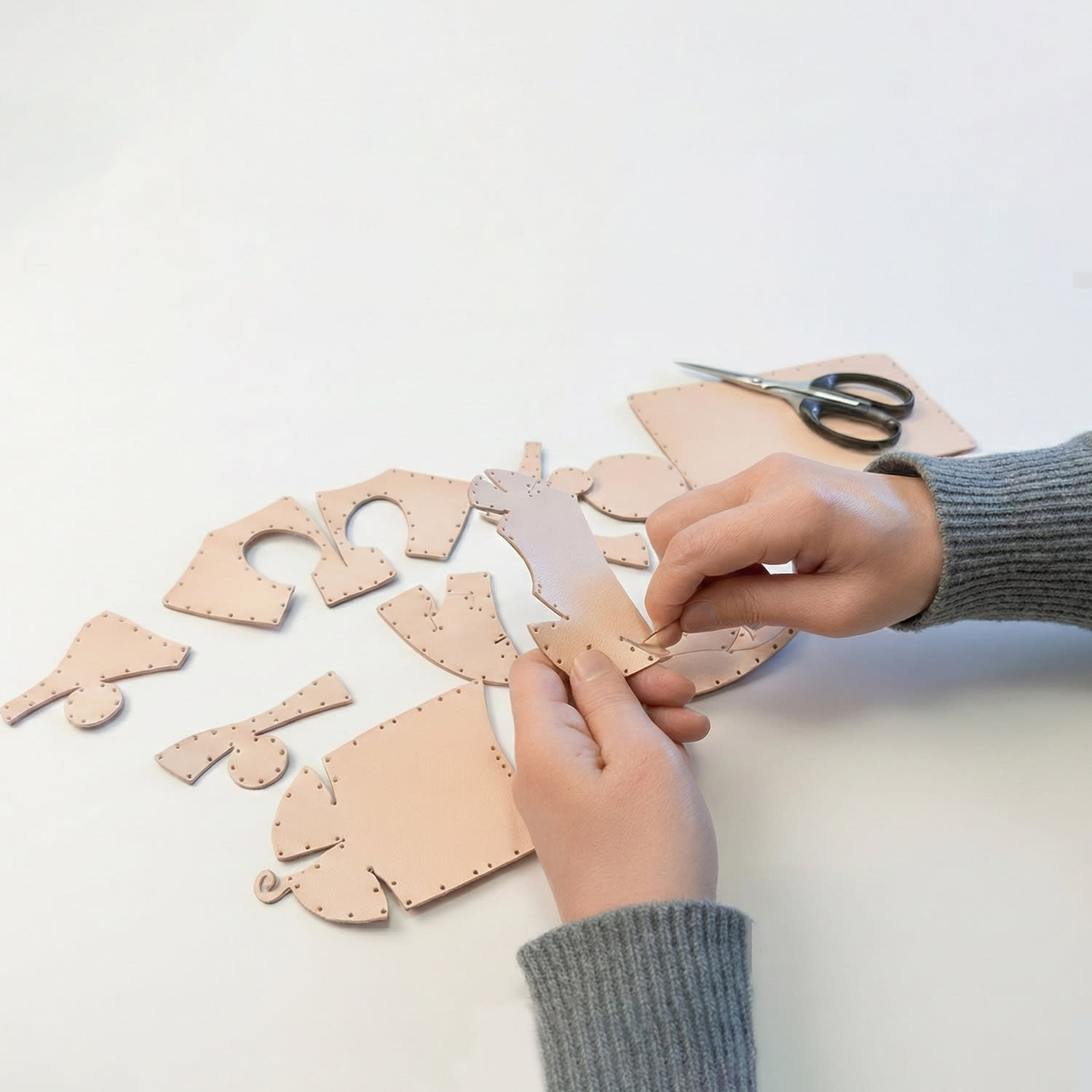
The first question wasn’t what to make. It was what kind of time to create.
I kept thinking about people I knew — not in crisis, not unhappy in any obvious way — but somehow not quite present. Responsive, busy, connected. And yet somewhere underneath that, a little bit lost. The information was endless. The speed was relentless. And the more there was to react to, the harder it became to feel what you actually felt.
I wanted to make something that could return a person to themselves, just briefly. A small interruption. Not an escape — something more honest than that. A structure for slowing down.
That led immediately to one decision: it had to be a kit.
A finished object can be admired. You look at it, appreciate it, set it somewhere. The experience is complete before your hands are involved.
A kit is different. A kit requires participation. You are not receiving something — you are inside the making of it. Your attention goes to what your hands are doing. The outcome is uncertain until it isn’t. And somewhere in that uncertainty, something shifts. The mind, which had been moving very fast, begins to move at the speed of the work.
That’s what I was trying to sell. Not an object. The time inside the making of one.
Once that was clear, the question became: what material makes that time work?
I thought about wood. Wood is structurally strong, and there’s a long tradition of wooden model kits. But wood has a hardness to it — a consistency of resistance — that pushes the experience toward construction. You feel like you’re building something. That’s fine, but it wasn’t quite what I was after. I wanted something less like assembly and more like contact.
Paper was too light. There’s something about paper that feels consumable — like the experience passes through it without leaving a trace. I needed a material that accumulated time, that changed with handling, that remembered being touched.
Ceramic required fire, equipment, a workshop. It was too far from ordinary life. I wanted something that could happen at a kitchen table, on an evening, without preparation.
Leather was the answer, but not one I arrived at quickly.
What leather has — and what I don’t think any other material combines in quite the same way — is this: temperature, smell, softness, and resistance, all at once. It is warm in a way that glass and plastic are not. It has a faint biological quality that reminds the hands they are touching something that was once alive. And it pushes back, slightly, in a way that requires a small amount of force. That resistance is important. It means you are present for the encounter.
And leather holds time. Touch it repeatedly and it changes — not breaking down, but recording. The surface deepens. The color shifts. Whatever has touched it leaves something behind. For a material that was supposed to be about time, this felt essential.
Then there was the sewing.
Pulling a waxed thread through pre-cut leather, again and again, in the same motion — there is something meditative in that repetition. The breath settles. The mind follows the hands. It is not difficult, but it requires enough attention that nothing else fits alongside it. That focus is the point. That is what was being sold.
Looking back, I think Kyoto Makotoya was never quite a craft brand. It was closer to a small, quiet argument that human beings need — occasionally, briefly — to move at the speed of their hands. Leather was the material that made that argument possible. The owl, the goldfish, the small bird that would come later: these were the forms the argument took.
The object was the result. The time was the product.
Muneshige Tanigawa / Kyoto Makotoya
最初の問いは、何を作るかではなかった。 どんな時間を作れるか、だった。
ずっと考えていたのは、知っている人たちのことだ。 危機の中にいるわけでも、明らかに不幸なわけでもない。 でも、どこかここにいない感じがする人たち。 反応して、動いて、繋がっていながら、 何かの手応えを失っているような人たち。 情報は終わらない。速度は緩まない。 反応すべきことが増えるほど、自分が何を感じているかがわからなくなっていく。
そういう人が、少しだけ自分に戻れる構造を作りたかった。 逃げ場ではなく、もっと正直な何か。 ゆっくりになるための、小さな仕掛け。
そこから一つの結論に辿り着いた。 キット形式でなければならない、と。
完成品は、鑑賞できる。 見て、受け取って、どこかに置く。 手が関わる前に、体験は終わっている。
キットは違う。 キットは、参加を求める。 受け取るのではなく、制作の中にいる。 注意は手の動きへ向かう。 結果は、完成するまでわからない。 その不確かさの中で、何かが変わる。 速く動いていた頭が、作業の速度に合わせ始める。
売ろうとしていたのは、物ではなかった。 物を作っている時間だった。
それが決まると、次の問いが来た。 その時間を成立させる素材は何か。
木を考えた。 構造体として強く、木製模型キットの長い歴史がある。 でも木には固さがある。一定の抵抗がある。 体験が「組み立て」に寄っていく。 それはそれで良いけれど、自分が求めていたのは、 もう少し「接触」に近いものだった。
紙は軽すぎた。 消耗品のような感覚がある。 体験が通り過ぎていく。痕跡が残らない。 時間が積み重なる素材が必要だった。
陶器は生活から遠かった。 火が必要で、設備が必要で、工房が必要だった。 夜の台所で、何の準備もなくできるものが欲しかった。
革が答えだった。ただし、すぐに辿り着いたわけではない。
革が持っているものは、他の素材が一つにまとめて持っていないものだと思う。 温度、匂い、柔らかさ、抵抗。 それが同時にある。 ガラスやプラスチックとは違う温かさがある。 かすかな生物感がある。かつて生きていたものを触っているという感覚。 そして少し押し返す抵抗がある。 その抵抗のために、手が現実にいる。
革は時間を保持する。 何度も触れると変化する。壊れるのではなく、記録する。 表面が深くなる。色が変わる。触れたものの痕跡が残る。 時間についての素材を探していたのだから、これは必然だった。
そして、縫うという行為があった。
ロウびきの糸を、あらかじめ穴の開いた革に通し続ける。 同じ動作を、繰り返す。 その反復の中に、少し瞑想的なものがある。 呼吸が整う。頭が手に従い始める。 難しくはないが、十分な注意を必要とする。 だから他のことが入ってこない。 その集中こそが、売ろうとしていたものだった。
振り返ると、京都諒屋はクラフトブランドではなかったかもしれない。 どちらかといえば、小さな静かな主張だった。 人間は時々、自分の手の速度で動く時間が必要だという主張。 革は、その主張を成立させた素材だった。 後に来るフクロウ、金魚、小鳥たちは、その主張が取った形だった。
物は結果だった。 時間が、プロダクトだった。