
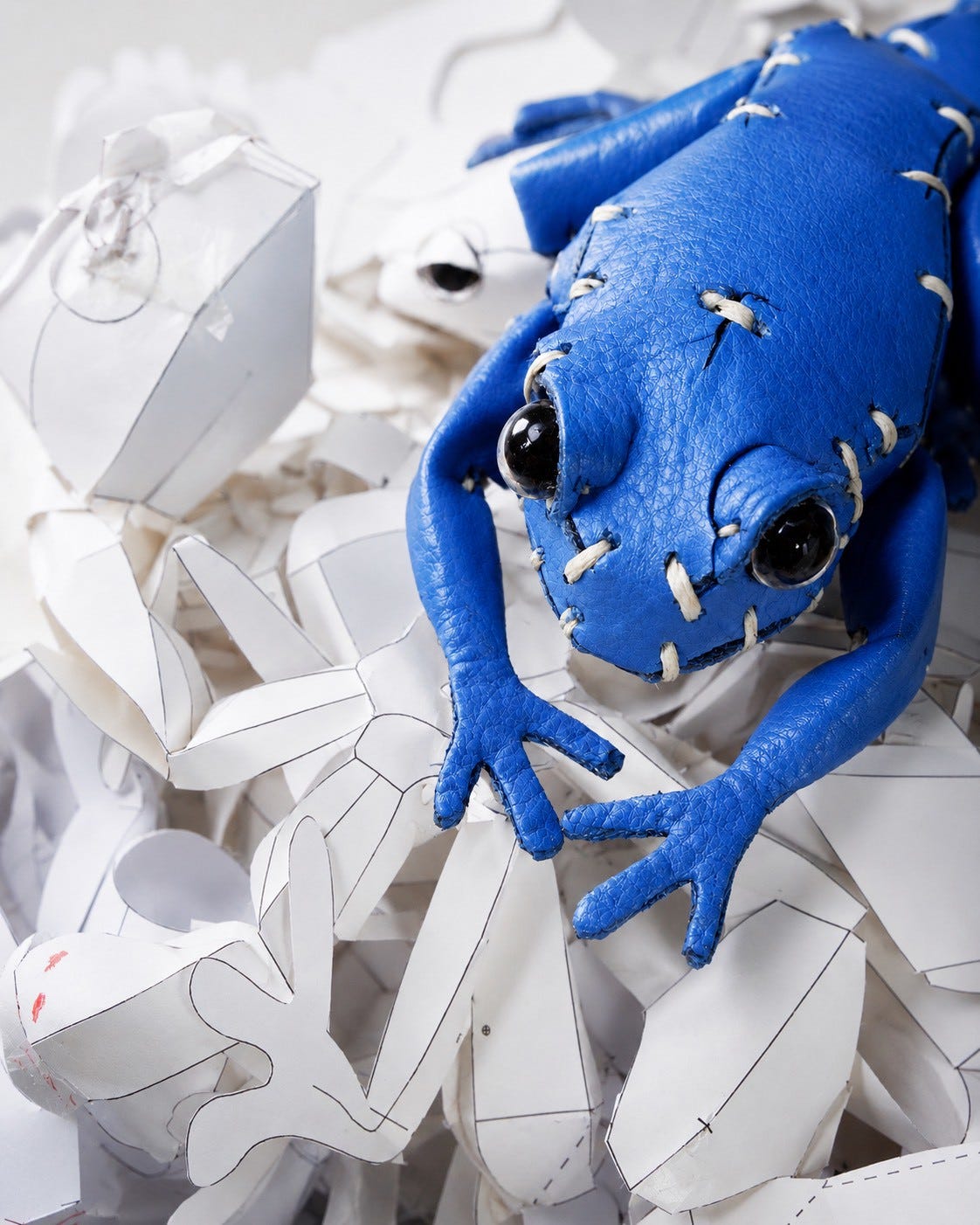
We are currently developing a new leather model kit: a frog. The die order was sent to the factory just last week — the data submitted, the decision made. It will be a little while longer before it is ready. Those who follow along on Instagram may have already caught glimpses of it taking shape.
Before any pattern is drawn, there is a question that has to be answered together.
When a new motif is chosen — a frog, a fish, a bird — we spend time looking at what already exists. Every object that has been made from that motif, in every material, in every era that left a record. We look at all of it. Not to copy, but to understand what has already been identified as essential. What people who made these things before us believed could not be removed.
From that, we try to find our own answer to the same question: what stays, and what can go.
The constraints are real and specific.
Our kits come in two box sizes. That means, before a pattern is designed, the finished size of the model has already been decided. From the size comes the number of parts — somewhere between five and eighteen, depending on the box. Too few parts, and the model loses its resemblance to the thing it represents. Too many, and it won’t fit. Between those two limits, there is a narrow range where the work has to happen.
This is not a constraint we work around. It is a constraint we design inside of.
I trained as a garment pattern-maker. Several of the people who work on these kits have the same background. The reason this matters is not just technical overlap — it is a shared way of thinking about how flat material becomes a three-dimensional form.
In garment making, you begin with a body. The body is already there. You work toward it. In leather model kit making, the body does not yet exist. The three-dimensional form has to be created before the pattern can begin. The model is not a reference you borrow. It is something you have to build.
The discovery that these two practices were connected came, like many good discoveries, without announcement.
When working on something new, this is a common experience: the problem is visible before the solution is. You can see exactly what needs to happen, but not yet how to make it happen. And then, at some point — not gradually, but suddenly — a missing piece fits. The way a jigsaw puzzle piece, once found, seems obvious. It was always the right shape. You simply hadn’t seen where it belonged.
Sometimes the piece is a skill already inside you, applied in a way it was never quite intended for. Sometimes it arrives from somewhere unexpected — a conversation, something read, a technique borrowed from a completely different field. The clothing pattern techniques were already in me. Years of training. What I hadn’t seen was that they were waiting for exactly this problem to arrive.
Finding that garment-making and leather model kit development were, at some level, asking the same questions — how flat material becomes form, how seams carry or conceal the work — felt, in a word that Japanese uses well, like 縁. An existing connection that had simply not yet been seen.
For the frog, we built it in parts.
The eyes first — the large, characteristic eyes that make a frog recognizable at any scale. Then the front legs, then the hind legs, each one worked on separately until it held the right proportion and gesture. Then the body. And then, finally, all of these combined — adjusted until the whole thing read as a single form, not a collection of pieces.
In recent years, we’ve done most of this with a 3D printer. It lets us make and remake until the model is right, without having to fix what can’t be unfixed. By the time we start pressing paper against it, we already know what we’re working from.
The process of extracting a pattern from a three-dimensional form is, in a sense, the reverse of papercraft.
In papercraft, you begin with a flat sheet and fold it into a shape. Here, you begin with the shape and unfold it back into flat pieces. You press paper against the surface of the model, trace the contours, and try to bring the curved form down onto a plane without losing what it was.
It doesn’t work cleanly. Curves don’t flatten without somewhere giving way. Where the paper bunches or folds, you cut. Where it gaps, you decide whether to merge the pieces or carry the seam. These decisions are not made in advance. They are made at the surface, with the hands working and the mind slightly ahead of them — thinking about where the seam can be hidden, where the volume needs to be added back in when the leather is sewn.
The head and the hands are doing different things at the same time.
The head holds the finished form — the frog as it should look when assembled. The hands read what is actually in front of them: the slight rise of a cheekbone, the way the surface curves inward at the neck. Neither one is sufficient alone. The head without the hands produces a pattern that exists on paper but fails in leather. The hands without the head produce pieces that fit the model but don’t add up to the animal.
What you’re looking for is the pattern that satisfies both.
The first time you cut the pattern in leather and sew it, the thing you watch most carefully is whether the parts close correctly.
Two pieces that are dimensionally equal can still fail to meet. When leather is sewn and the seam pulls into a three-dimensional curve, the geometry changes. A gap that wasn’t visible in the flat pieces becomes visible in the form. A surface that looked smooth in the pattern bunches when the tension of the thread enters it.
You sew it. You hold it. You run your fingers over the seams and feel what the eye might not catch. Then you take it apart, if needed, and adjust.
The pattern is not something you draw and then execute. It is something you find, through the material, by making the thing badly enough times that you begin to understand what it wants to be.
Muneshige Tanigawa / Kyoto Makotoya
現在、新しい革模型キット「かえる」の開発に取り組んでいる。先週、金型工場に発注データを送ったばかりで、完成まではもう少しお待たせするかもしれない。インスタグラムでは開発途中の画像を何度か載せているので、見かけた方もいるかもしれない。
型紙を引く前に、一緒に答えなければならない問いがある。
新しいモチーフが決まると——カエル、魚、鳥——すでに存在するものを時間をかけて見る。あらゆる素材で、あらゆる時代に、記録が残っている限り、そのモチーフから作られたすべての物を。模倣するためではなく、何が本質として特定されてきたかを理解するために。自分たちより先にこれを作った人々が、外せないと判断したものを。
そこから、同じ問いへの自分たちの答えを探す。何を残し、何を手放せるか。
制約は現実的で、具体的だ。
キットには二種類の箱がある。つまり型紙を設計する前に、完成品のサイズはすでに決まっている。サイズからパーツ数が決まる——箱の大きさによって、五個から十八個の間。パーツが少なすぎると、模型がそのモチーフらしく見えなくなる。多すぎると、箱に収まらない。その二つの限界の間に、仕事が起きる場所がある。
この制約を回避するのではない。この制約の内側で設計する。
私は服飾パタンナーとして訓練を受けた。キット制作に携わるスタッフも同じ背景を持っている。重要なのは技術的な共通点だけではない。平面の素材が立体の形になるとき何が起きているか、という思考の仕方を共有しているということだ。
洋服作りでは、身体が最初からある。身体はすでにそこにある。それに向かって作る。革模型キット制作では、身体はまだない。型紙を始める前に、立体の形を作らなければならない。モデルは借りてくる参照物ではない。自分たちで作るものだ。
この二つの仕事が繋がっているということに、気づいたのは予告なく、だった。
新しいことに取り組み始めたとき、これはよくあることだと思う。問題は見えている。でも解決策は、その時点ではまだない。見えている問題に向かって進み続けているうちに、ある時、欠けていたジグソーパズルのピースのように、ピタッとはまる瞬間がある。見つかった瞬間に当たり前に見えるピースのように。最初からその形だった。どこに属するかが見えていなかっただけで。
解決するのが、すでに身につけていた技術を変則的な使い方で当てはめた場合もある。全く知らなかった技術を偶然知ることで、あっさり解決することもある。服飾のパターン技術は、自分の中にすでにあった。長年かけて身につけてきたものだった。それが、革模型キットという問題のために待っていたとは、見えていなかっただけで。
服飾と革模型キットの開発が、ある意味で同じ問いを立てていると気づいたとき——平面の素材をどう形にするか、縫い目がどう仕事を担い、どう隠れるか——日本人がよく使う言葉が浮かんだ。「縁(えん)」。ずっとそこにあった繋がりが、見えるようになる瞬間のことだ。
カエルは、パーツごとに作った。
まず目——大きな、特徴的な目。どんなサイズでもカエルとわかる、あの目。次に前足、次に後ろ足、それぞれを独立して、正しい比率とかたちになるまで作った。それからボディ。最後に全部を合体させた——全体が一つの形として読めるまで、バラバラなパーツの集合ではなく。
近年はほとんど3Dプリンターを使う。作り直しを、元に戻せない何かを固定する前に何度でもできる。紙を当て始める頃には、何を基準に作業しているかがすでにわかっている。
立体の形から型紙を取り出す工程は、ある意味でペーパークラフトの逆再生だ。
ペーパークラフトは、平らな紙から始めて形を折り上げる。ここでは形から始めて、平らなパーツに折り戻す。モデルの表面に紙を当て、輪郭をなぞり、曲面を平面に降ろしながら、元の形が何だったかを失わないようにする。
きれいにはいかない。曲面は、どこかが破綻しなければ平らにならない。紙が溜まるところには切り込みを入れる。隙間ができたところは、パーツを繋ぐか縫い代として持つかを決める。これらの判断は事前には決まらない。表面で決まる。手が動き、頭がその少し先にいて——縫い目をどこに隠せるか、革が縫われたときにどこでボリュームを足す必要があるかを、考えながら。
頭と手は、同時に別のことをしている。
頭は完成した形を持っている——組み立てたときにこうあるべき、というカエルの像。手は目の前にあるものを読んでいる。頬の微妙な張り出し、首のあたりで内側に入っていく表面のカーブ。どちらか一方だけでは足りない。手のない頭は、紙の上では存在するが革の中で失敗する型紙を作る。頭のない手は、モデルには合うがカエルには見えないパーツを作る。
両方を満たす型紙を探している。
型紙を革に写して縫う、その最初の瞬間に最も神経を使うのは、パーツとパーツの間に隙間が生まれないかどうかだ。
寸法的に一致している二枚のパーツが、縫い合わさったときにうまく合わないことがある。革を縫って縫い目が立体的なカーブに入っていくとき、形状は変化する。平らな状態では見えなかった隙間が、形になると現れる。型紙では滑らかに見えた面が、糸の張力が入ったときに寄れる。
縫って、持って、指で縫い目をなぞる。目には映らないものを、手で感じる。必要であれば解いて、また調整する。
型紙は、引いてから実行するものではない。素材を通じて、見つけるものだ。何度もうまくいかない作り方を積み重ねることで、それが何になりたいかが見え始める。