
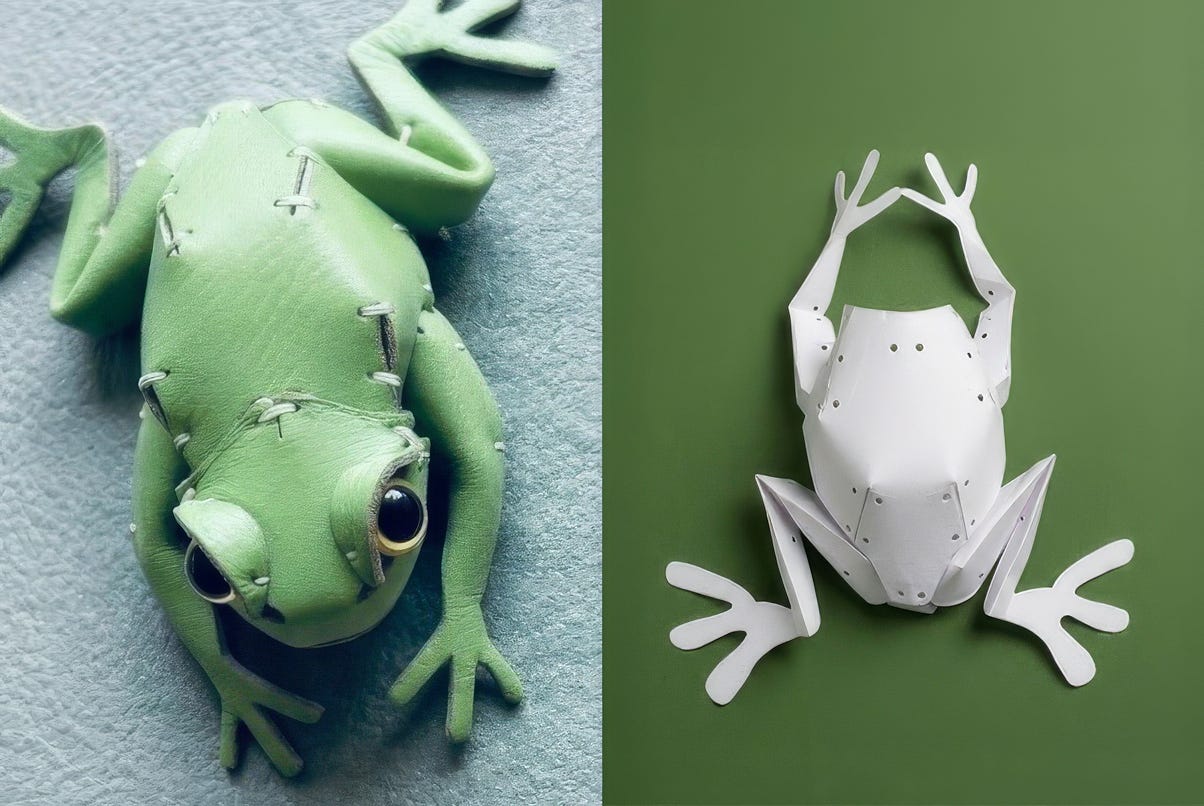
By the time a pattern approaches its final form, the work has changed character.
The early stages are about finding. Pressing paper against a model, cutting where the surface resists, sewing test pieces to see whether the logic holds in leather. There is a feeling of searching, of moving toward something that isn’t yet clear. Failed samples are information. You learn more from what goes wrong than from anything else.
But at some point, the searching phase ends and a different kind of work begins.
For the frog kit, we made around thirty samples before the pattern was ready for the metal die.
Some of these were full assemblies. Some were single parts, tested in isolation before being integrated with the others. Each series of cuts represents a direction tested and either confirmed or set aside. The pile of rejected samples is not failure. It is the record of a process. It shows where the form resisted and what we tried in response.
We have made enough kits now to know, before the first sample is cut, roughly where the difficulty will be. The shape of the problem is familiar. But knowing where the difficulty is does not make the difficulty smaller. You still have to work through it.
The hind legs of the frog took longer than anything else.
A frog’s hind legs are not decorative. They are the source of the animal’s energy — coiled, compressed, holding the potential of a leap that hasn’t happened yet. If the completed model doesn’t carry that quality, the thing in your hands is not really a frog. It may be frog-shaped. It is not frog.
The solution came from the leather itself.
Leather can be folded. Not bent sharply, the way plastic snaps, or forced into a curve the way wood resists — but folded, like something that was always meant to fold. You can crease it and it holds the crease. You can shape it and it accepts the shape. The hind legs of the frog are formed by folding the leather parts in a specific way, so that the compressed energy of a jumping posture is held in the form even when the model is still.
This is a construction that plastic or wood cannot make. The material, in this case, is not just a medium. It is the reason the solution is possible.
The final rounds of refinement are subtractive.
The question is no longer whether the form is right. It is whether there is any stitch that can be removed without the form failing. One less stitch means one less moment of work for the person assembling the kit. It means a simpler rhythm, a cleaner process, a shorter path between beginning and holding the finished thing in your hands.
Every unnecessary stitch is a small tax on the attention of the person making it. You find them by asking: if this stitch were gone, what would happen? If the answer is nothing, the stitch is gone.
There is almost never a moment when the direction becomes suddenly clear.
I have made enough of these to know that the feeling of breakthrough — the sample where everything clicks — is rare. What actually happens is more gradual and less satisfying to describe. The samples get closer. The problems that remain get smaller and more specific. The gap between where the form is and where it needs to be narrows, slowly, without announcement.
At some point, the gap closes. Not with a feeling of completion, exactly — more with the absence of remaining objections.
A kit is made to be assembled. That is the experience we are designing toward — someone at a table, the parts arranged in front of them, the slow rhythm of the work building toward a form that wasn’t there before.
But I have come to think of what we do during development in the same terms. We are also assembling. Not leather parts — but techniques, judgments, material properties, the accumulated record of what held and what didn’t. Every decision made across thirty samples, every stitch removed in the final rounds of refinement, is a piece being placed. What we are building is not a model. It is the conditions under which someone else’s making becomes possible.
The product has a double structure. The kit is assembled by the person who buys it. But the development that made the kit possible was itself an act of assembly. The two are invisible to each other. Neither exists without the other.
I don’t send the order for the metal die until I feel that what can be done has been done.
Not until the deadline. Not when the samples are good enough. When everything I know how to do has been put into the pattern, and what remains is the question that only the die, and the first leather parts cut from it, will be able to answer.
The work continues after the die is made. There will be adjustments. There always are. But the order is placed only when I can say, without qualification: I have found what there is to find here.
Until that point, there is still a stitch that can be removed.
Muneshige Tanigawa / Kyoto Makotoya
型紙が最終的な形に近づくころ、作業の性質が変わる。
初期の段階は、探すことだ。モデルに紙を当て、表面が抵抗するところで切り、テストピースを縫って、その論理が革の中で成立するかを確かめる。まだ見えていないものに向かって動いている感覚がある。失敗したサンプルは情報だ。うまくいかないことから、他の何よりも多く学ぶ。
しかしどこかで探す段階が終わり、別の種類の作業が始まる。
カエルの模型キットでは、金型が発注できる状態になるまでに、およそ三十のサンプルを作った。
完成品として組み立てたものもある。他のパーツと組み合わせる前に単独でテストしたパーツだけのものもある。一つ一つの試みは、ある方向性を検証して、確認するか、手放すかした記録だ。失敗したサンプルの積み重ねは、失敗ではない。それは工程の記録だ。形がどこで抵抗し、自分たちが何を試みたかを示している。
すでにいくつもキットを作ってきたので、最初のサンプルを切り始める前から、どこに難しさがあるかはだいたいわかる。問題の形は見慣れている。しかし、どこに難しさがあるかがわかっても、その難しさは小さくならない。やはりそこを通り抜けなければならない。
カエルの後ろ足には、他のどの部分よりも時間がかかった。
カエルの後ろ足は、装飾ではない。その動物のエネルギーの源だ——圧縮され、まだ起きていない跳躍の可能性を内側に溜めて、コイルのように。完成した模型がその質を持っていなければ、手の中にあるものは本当の意味でカエルではない。カエルの形をしているかもしれない。でもカエルではない。
解決は、革そのものの中から来た。
革は折れる。プラスチックのように折れ曲がって割れるのでも、木のように力に抵抗して曲がるのでもなく——折り紙のように、最初からそう折れるために存在していたかのように、折れる。折り目をつけるとその形を保つ。形を与えると受け入れる。カエルの後ろ足は、革のパーツを特定の方法で折り曲げることで作られている。模型が静止していても、跳ぶ直前のバネのような姿勢の緊張が、形として保たれるように。
プラスチックでも木でも作れない構造だ。この場合、素材は単なる媒体ではない。解決を可能にした理由そのものだ。
最終段階の修正は、引き算だ。
問いはもう、形が正しいかどうかではない。この縫い目を外したとき、形が崩れないか——それだ。縫い目が一つ減れば、キットを組み立てる人の作業が一つ減る。リズムがシンプルになり、工程が明確になり、始めてから完成品を手に持つまでの道が短くなる。
余分な縫い目は一つ一つ、作る人の注意に対する小さな負荷だ。外せる縫い目は、問うことで見つかる。これがなかったら何が起きるか。答えが「何も起きない」なら、その縫い目はなくなる。
方向性が突然はっきり見える瞬間は、ほとんどない。
これだけ作ってきて、それがわかった。すべてがはまる感覚——あのサンプルだ、という瞬間——は、稀だ。実際に起きることは、もっと緩やかで、描きにくいものだ。サンプルが少しずつ近づいていく。残っている問題が、より小さく、より具体的になっていく。形がある場所と、あるべき場所の間の隙間が、静かに、予告なく縮まっていく。
どこかで隙間が閉じる。完成した感覚というよりも——残っている異議が、なくなる感覚として。
模型キットは、組み立ててもらうための商品だ。設計している体験はそこにある——テーブルの前に座った誰かが、パーツを手前に置き、ゆっくりしたリズムの中で、それまでなかった形へと向かっていく。
でも、開発の工程で自分たちがやっていることも、同じ言葉で語れるのではないかと思うようになった。私たちもまた、組み立てている。革のパーツではなく——技術、判断、素材の性質、何がうまくいき何がいかなかったかという積み重ねを。三十のサンプルで下されたすべての判断、最終段階で外されたすべての縫い目は、置かれたピースだ。作っているのは模型ではない。誰かの「作ること」が起きるための条件だ。
このプロダクトは、組み立ての二重構造でできている。キットは、買った人によって組み立てられる。でも、そのキットを可能にした開発もまた、組み立てだった。二つは互いに見えない。でも、一方がなければ他方は存在しない。
できることをすべてやったと感じるまでは、金型を発注しない。
締め切りが来たからではなく。サンプルが十分よくなったからでもなく。自分が知っているすべてを型紙に込めて、残っているのが、金型と、そこから切り出された最初の革のパーツだけが答えを出せる問いになったとき。
金型ができた後も作業は続く。調整は必ずある。いつもそうだ。でも発注するのは、ここに見つけられるものは見つけた、と言い切れるときだけだ。
そこに至るまでは、まだ外せる縫い目が一つある。