One day, it did.
The name was Grain Patch.
For a long time before that, the thing had no name at all.
The white prototype sat on a corner of my desk while I worked on other things. Every so often I picked it up, turned it over a few times, and put it back down. It didn’t seem to mind. It just sat there with the face of a small ghost — the ghost of something that hadn’t been born yet.
I knew plenty about what it wasn’t. It wasn’t a leather accessory. It wasn’t a digital business card. It wasn’t a gadget — nothing that quiet has ever been a gadget. Naming what a thing isn’t is easy work. You can keep at it for weeks and get nowhere. I speak from experience.
And the real question — what is this thing I’m trying to make? — I asked often enough. The question kept politely declining to answer.
My workroom, by the way, contains surprisingly little leather for a leather brand. A MacBook wired to two monitors. A Logitech keyboard and mouse I’ve been loyal to for years. A 3D printer. A cutting machine that cuts material exactly as the data tells it to. That’s the whole room.
Everything in it answers to a name. Most of it answers to a model number, too. And in the middle of all that well-named equipment sat the one object that answered to nothing.
It wasn’t an unpleasant silence. But it was there, the way a missing tooth is there.
Then one afternoon, apropos of nothing, I found myself thinking about bandages. Real ones.
A bandage doesn’t heal a wound. That isn’t its job, and it has never once pretended otherwise. Its job is to stay close — through the hours and days it takes — without asking to be noticed, without demanding a thing. It is simply there, quietly, until the day it isn’t needed anymore. And then it leaves without a speech.
Something about that felt exactly right. I can’t explain it better than that. It was simply, precisely, it.
I didn’t want to change whoever would carry this thing. I didn’t want to inspire them or instruct them — the world already has more than enough things trying to do that. I wanted it just to be there. In the wallet. In the bag. Near the skin. The way something small can accompany a life without making any claim on it.
So that was the Patch. Half of the name had been sitting in the first-aid box all along.
Then there was the Grain.
Leather has a grain — the natural pattern pressed into its surface. Every hide carries its own, worked into it by years of movement and weather, and no two are alike. Leather is strict on this point. About as strict as fingerprints.
So far, so much leather-craft talk.
But the word reaches further than that.
The grain of wood. A grain of sand. The grain of a voice. The way a thing naturally becomes itself — the texture that tells you what something is made of.
People have a grain too. The way a person walks. The way they think. The words they keep going back to, again and again, mostly without noticing. Their own grain — particular, unrepeatable, already there long before anyone points it out.
I didn’t want to make something that would change a person’s grain. Plenty of things are in that business already.
I wanted to make something that would stay alongside it.
A patch that belonged to the grain of whoever carried it.
When the two words finally sat down next to each other, there were no other candidates. There never had been, apparently. I just hadn’t been introduced.
I said the name out loud a few times, to see how it walked around the room.
It walked fine.
The leather ones, by the way, are made from a single piece of hide.
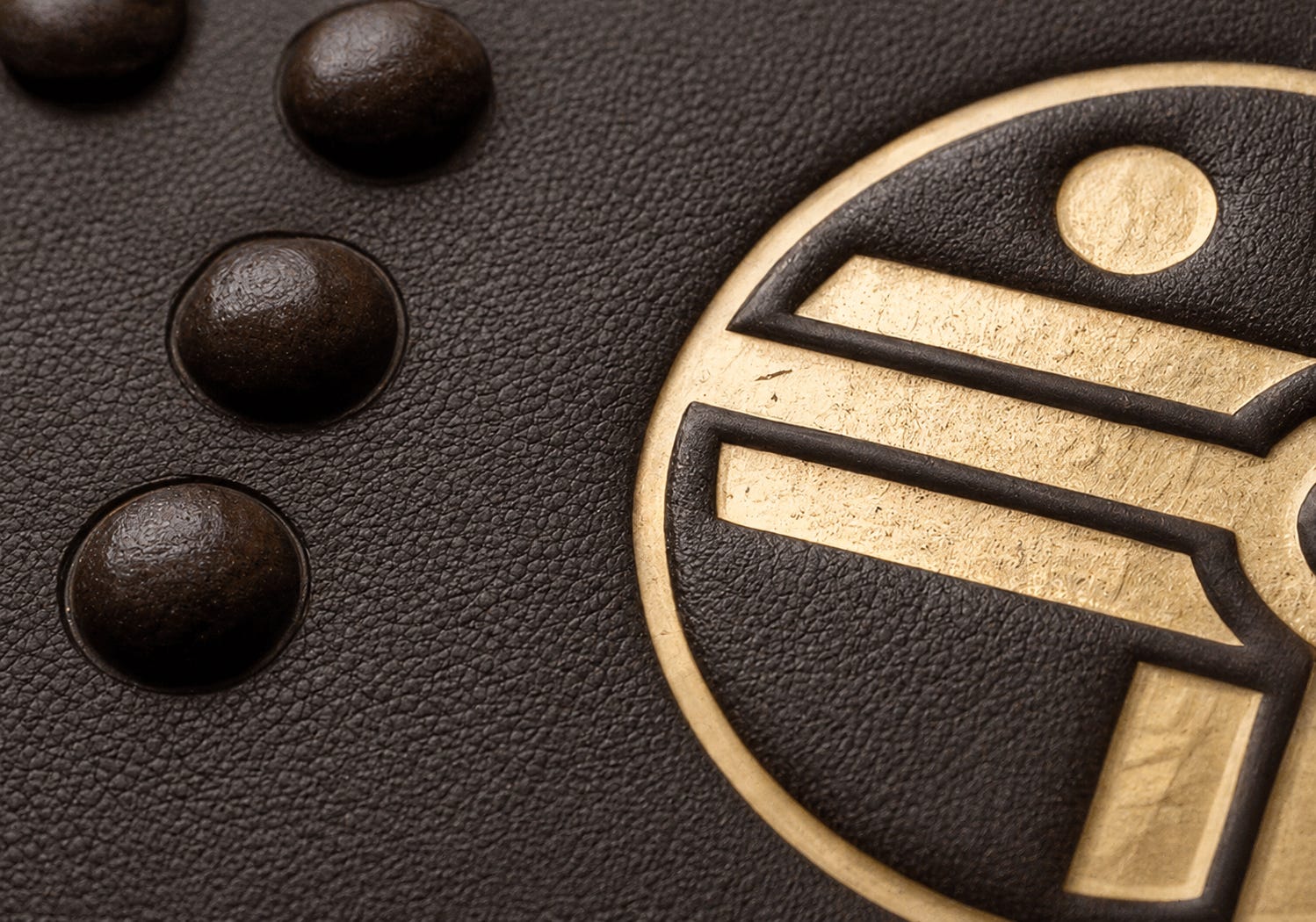
The raised pad in the center is not a part attached on top. The small dots at either end are not set in. There is no cutting and no joining anywhere — the whole form is persuaded out of one flat piece of leather, using nothing but heat, pressure, and patience. The grain runs unbroken from end to end.
I was stubborn about this in a way that puzzled even me. The reason arrived later, the way reasons tend to, around here.
An object shaped like a bandage shouldn’t begin its life by being cut.
It felt exactly that simple.
The app that writes into it needed a name too.
That one took about a minute. Writing a word into leather is a kind of sealing — the way a letter used to be closed with wax, and stayed closed until it reached the right hands. The object itself is a seal too, a small thing you press onto what you carry. And a bandage, come to think of it, is also something you seal over skin.
Three directions, one word — like three people turning up at the same café at the same hour, none of them having arranged a thing.
Seal.
There is one more thing already written on every patch, before its owner writes anything at all.
A few raised dots, pressed into the leather. Most people will take them for the air holes of a bandage, which is fine. They’re meant to pass for that.
They’re braille. They read: ID.
Identification — because someone who cannot see can hold this patch out, and it will do the talking.
And identity — because whatever you choose to put inside it ends up being, in some small way, a description of who you are.
Looking back, I don’t feel I named any of it.
It’s closer to say that these things had known their names for a long time, and had been waiting — patiently, without any particular complaint — for someone to notice.
So now it had a name, a shape, and a place to keep things.
What it didn’t have yet was an answer to the harder question.
What kind of words deserve to be carried around?
I had a feeling about this one from the start. It wasn’t going to answer politely, either.
Continued in Part 3 — Invisible Words.
Muneshige Tanigawa / Kyoto Makotoya
名前を授かること
Grain Patch 連載 第2回(全4回)
ある日、その時が来た。
名前は、Grain Patchといった。
その日が来るまで、長いあいだ、そのものには名前がまったくなかった。
白い試作品は、机の隅に座っていた。僕がほかの仕事をしているあいだも、ずっとだ。ときどき手に取って、何度かひっくり返して、また元の場所に戻した。向こうが気にしている様子はなかった。まだ生まれていない何かの、小さな幽霊みたいな顔をして、ただそこに座っていた。
それが「何でないか」なら、いくらでも知っていた。革のアクセサリーではない。デジタル名刺でもない。ガジェットでもない——あんなに静かなガジェットを、僕は見たことがない。何でないかを数えるのは楽な仕事だ。何週間でも続けられるし、そしてどこにも辿り着かない。経験者として言っている。
肝心の問い——自分はいったい何を作ろうとしているのか?——なら、飽きるほど口にした。問いのほうは、丁寧に回答を辞退しつづけた。
ところで、革のブランドをやっている人間の作業部屋にしては、僕の部屋には驚くほど革気がない。モニターを二台つないだMacBook Proが一台。長年義理を通しているロジ社製のキーボードとマウス。3Dプリンター。素材をデータの言うとおりに切り抜くカッティングマシーン。部屋にあるのは、それで全部だ。
どれも、呼べば返事をする名前を持っている。たいていは型番まで持っている。そのよく名付けられた機材のまんなかに、何にも返事をしないただひとつの物体が座っていた。
嫌な沈黙ではなかった。でも、確かにそこにあった。抜けた歯が、そこに「ある」のと同じように。
そしてある午後、何の脈絡もなく、気がつくと絆創膏のことを考えていた。本物の絆創膏のことだ。
絆創膏は傷を治さない。それは彼らの仕事ではないし、彼らは一度だってそういうふりをしたことがない。彼らの仕事は、そばにいることだ。必要なだけの時間——気づいてくれと頼むこともなく、何かを要求することもなく。ただ静かにそこにいて、要らなくなった日が来ると、スピーチもなしに退場していく。
それだ、と思った。うまく説明できないのだけれど、それは正確に「それ」だった。
これを持つことになる人を、変えたいわけではなかった。励ましたいわけでも、教え導きたいわけでもない——そういうことをしたがるものなら、世の中にもう十分すぎるほどある。ただ、そこにいてほしかった。財布の中に。鞄の中に。肌の近くに。小さなものが、何の権利も主張せずに、誰かの日々に付き添っていくみたいに。
それがPatchだった。名前の半分は、最初から救急箱の中に座っていたわけだ。
次はGrainだ。
革にはグレインというものがある。表面に刻まれた自然の模様のことだ。一枚一枚の革が自分のグレインを持っている。何年ぶんの動きと天候がそこに練り込まれていて、同じものはふたつとない。この点について、革は厳格だ。指紋と同じくらい厳格だ。
——と、ここまでなら革職人の講釈である。
でもこの言葉は、もう少し遠くまで届く。
木目。砂粒。声の質感。何かが自然に自分自身になっていくときの、その方向。それが何でできているかを教えてくれる手触り。
人にもグレインがある。歩き方。考え方。ほとんど気づかないまま、何度も何度も戻っていく言葉。その人だけのグレイン——固有で、かけがえがなくて、誰かに指摘されるずっと前からそこにあるもの。
人のグレインを変えるようなものを、作りたいわけではなかった。その商売なら、もう十分に間に合っている。
そのグレインの隣に、いてくれるものを作りたかった。
持つ人のグレインに属する、パッチを。
ふたつの言葉がようやく隣同士に座ったとき、他の候補はひとつもなかった。どうやら最初からなかったらしい。僕が紹介されていなかっただけで。
その名前を、部屋の中でどんなふうに歩くのか、何度か声に出して試してみた。
ちゃんと歩いた。
ところで、革のほうの本物は、一枚の革から作られている。
中央のふくらみは、上から貼りつけたパーツではない。両端の小さなドットも、埋め込んだものではない。どこにも切れ目がなく、どこにも継ぎ目がない——熱と、圧力と、根気だけを使って、一枚の平らな革から、かたちの全部を説き伏せるように立ち上げている。銀面は端から端まで、一度も途切れない。
ここについての僕のこだわりは、自分でも不思議なくらい頑固だった。理由はあとからやって来た。このあたりでは、理由というのはたいていあとから来る。
絆創膏のかたちをしたものが、切られることから生まれるべきじゃない。
それだけの、単純な話だった。
書き込むためのアプリにも、名前が要った。
こちらは一分くらいで済んだ。言葉を革に書き込むというのは、一種の封入だ——手紙が封蝋で閉じられて、正しい手に届くまで閉じたままでいたように。この物体そのものも、持ち物に貼りつける小さなシールだ。そして絆創膏だって、考えてみれば、肌の上に貼って封をするものである。
三つの方向から、同じひとつの言葉がやって来た。誰も約束などしていないのに、三人が同じ喫茶店の同じ時刻に現れるみたいに。
Seal。
すべてのパッチには、持ち主が何かを書き込むより前から、すでに書き込まれているものがひとつある。
革に型押しされた、小さな点の並びだ。たいていの人は絆創膏の通気孔だと思うだろうし、それで構わない。そう見えるように作ってある。
あれは点字で、「ID」と読む。
Identification——目の見えない人がこのパッチを差し出せば、パッチが代わりに喋ってくれるから。
そしてIdentity——中に何を入れるかを選んだ時点で、それはその人がどういう人間かの、小さな記述になってしまうから。
振り返ってみると、どれについても、自分が名付けたという実感がない。
それぞれが自分の名前をとっくに知っていて、誰かが気づくのを——特に文句を言うでもなく、辛抱づよく——待っていた。そう言うほうが近い。
こうして、名前と、かたちと、ものをしまう場所ができた。
まだなかったのは、もっと難しい問いへの答えだ。
いったいどんな言葉なら、持ち歩くに値するのだろう?
この問いについては、最初から予感があった。こちらも、丁寧に回答を辞退してくるだろうという予感が。
第3回「見えない言葉」につづく。
Muneshige Tanigawa / Kyoto Makotoya