
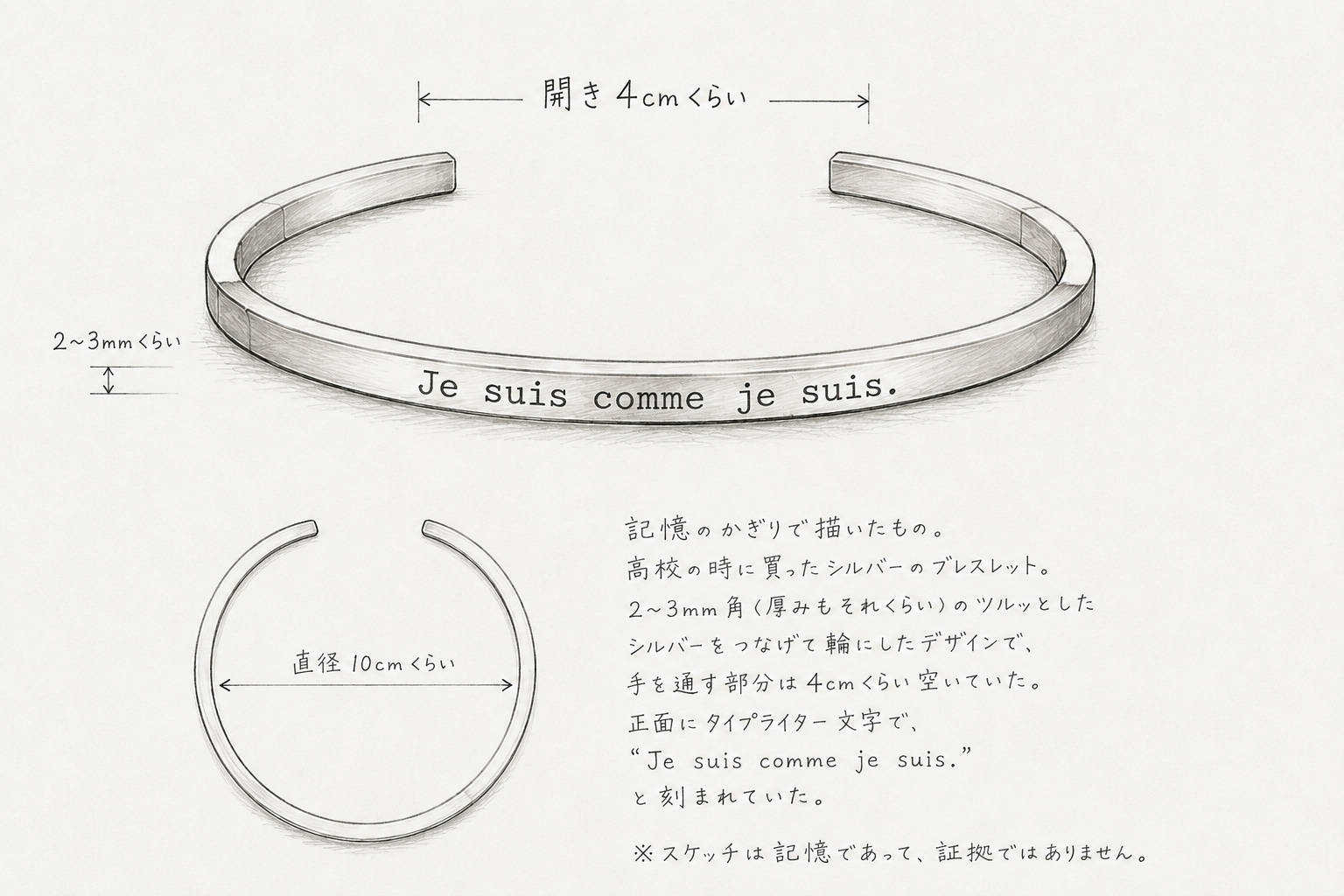
When I was in high school, I bought a silver bracelet.
A thin one, with small letters engraved along the band: Je suis comme je suis.
I should be honest here: I didn’t buy it for the words. I couldn’t read French. I bought it because it was beautiful — the delicate line of the thing, the letters marching along it in a quiet little procession. That was the whole reason.
The meaning arrived later. I am as I am.
And from the day I learned that, it was a different bracelet. Same silver, same weight on the wrist. But now it said something — to me, and only to me, every time I happened to notice it there.
I had been wearing the words long before I knew I needed them. Things work in that order more often than you’d think.
This year, I’ve been thinking about that bracelet a lot. Why now, after all this time, I couldn’t really tell you. But some memories are like that. They’ll wait decades for their turn.
I read paper books. I don’t fold the corners of pages — I’ve never once managed it, the way some people can’t crack an egg with one hand. Instead I use bookmarks I make myself, out of leather left over in the workshop.
A bookmark says nothing all day. It doesn’t ask to be looked at. It waits inside the book, and when you come back — tomorrow, next week, whenever — it’s exactly where you left it, holding your place without comment.
That, I’ve come to think, is the right distance between a person and their words. Not framed on a wall. Not shouting from a screen. Just kept. Close, silent, exactly where you left them.
Earlier this year I spent three days at a trade fair in New York, standing behind a small table in a room full of things that wanted to be seen.
The room taught me one thing, and it taught it thoroughly: if the reason for an object doesn’t reach someone, the object doesn’t exist for them. It isn’t the thing that’s invisible. It’s the reason.
On the flight home, somewhere over the Pacific, I kept turning this over. You can’t put a reason on display.
But you might be able to carry one.
Japanese has an old word for all of this — kotodama. Written down like that, it looks mystical, and it sometimes gets translated in ways that make it sound like something out of folklore. The way it actually lives in daily life is far plainer. It’s a feeling — older than any explanation of it — that words are not entirely weightless. That a word kept close behaves differently from a word left lying around.
I doubt the feeling is particularly Japanese, to be honest. A photograph in a wallet. A ticket stub that has survived every single spring cleaning. A letter that stayed in a coat pocket long after it was answered.
Everyone has carried words. Most of us just never got around to calling it anything.
So when the leather bandage finally became Grain Patch, one decision mattered more than all the others put together.
The words would not be visible.
Nothing is printed on the surface. The leather shows its grain, a small gold crest, a few raised dots — and that’s all. The words are inside. Written once, then sealed.
Hold your phone over the patch, and they appear. Put the phone away, and they withdraw, like something slipping back underwater.
There is an old fable about a woodcutter who drops his axe into a spring. A spirit rises from the water holding a golden axe — is this the one you lost? Then a silver one. In that story, honesty gets rewarded generously.
I’ll say it up front: the patch runs a more modest operation. What rises when you hold your phone over it is exactly what you dropped in. Your own words. No gold, no silver, no spirit.
Depending on the day, that seems to me the better eal.
If the words sat on the surface, they would turn into decoration. A slogan, worn outward, performing for whoever happens to walk past.
Sealed inside, they stay what they are. Words. Yours. Facing you and no one else.
It took me years to notice that the bracelet had been doing the same trick all along.
Its words sat right out in the open — engraved, polished, there for anyone to see. But they were in French, and where I lived, hardly anyone happened to read French. The words were published and hidden at the same time. A secret in plain sight, wearing the disguise of an ornament.
Maybe that’s why I never got tired of them. They didn’t perform. They just waited for me to look.
You can’t see them. You just know they’re there.
Which leaves exactly one question — the one this whole object was built to ask.
What would you wear?
Continued in Part 4 — Wear Your Words.
Muneshige Tanigawa / Kyoto Makotoya
見えない言葉
Grain Patch 連載 第3回(全4回)
高校生のとき、シルバーのブレスレットを買った。
細いバンドに、小さな文字が刻まれていた。Je suis comme je suis.
正直に言うと、言葉に惹かれて買ったのではない。フランス語は読めなかった。買ったのは、それがきれいだったからだ。華奢な線と、その上を静かな行列みたいに進んでいく文字の並び。理由はそれで全部だった。
意味はあとからやって来た。「私は、私のままでいる」。
それを知った日から、それは別のブレスレットになった。同じ銀で、手首の上のも同じ。でも今や、それは何かを言うのだった——僕に、僕にだけ、ふと目に入るたびに。
必要だと知るずっと前から、僕はその言葉を身につけていたわけだ。物事は、思っているよりずっと頻繁に、その順番で起こる。
今年に入ってから、あのブレスレットのことをよく思い出す。なぜ今になって、と訊かれても答えられない。でも記憶にはそういうところがある。自分の出番を、何十年でも待っているのだ。
僕は紙の本を読む。ページの角は折らない。一度も折れたためしがない。片手で卵を割れない人がいるのと、たぶん同じことだ。かわりに、工房で余った革で自分の栞を作って使っている。
栞は一日じゅう何も言わない。見てくれと頼まない。本の中で待っていて、こちらが戻ってくると——明日でも、来週でも、いつでも——置いた場所に正確にいて、何のコメントもなしに続きを持っていてくれる。
それが、人と言葉のあいだの正しい距離なんじゃないかと、僕は思うようになった。額に入れて壁に掛けるのでもなく、画面の中で叫ばせるのでもなく。ただ、持っている。近くに、静かに、置いた場所のままに。
今年のはじめ、ニューヨークの見本市で三日間、小さなテーブルの後ろに立っていた。見られたがっているものであふれた、大きな部屋の中でのことだ。
あの部屋が教えてくれたことはひとつだで、そのかわり徹底的に教えてくれた。理由が相手に届かなければ、そのものは相手にとって存在しない。見えていないのは、ものではない。理由のほうなのだ。
帰りの飛行機の中で、太平洋の上のどこかで、僕はそのことを何度もひっくり返して考えた。理由は、陳列できない。
でも、持ち歩くことなら、できるかもしれない。
日本語には、この感覚の全体を指す古い言葉がある。言霊、という。こうして文字にすると神秘的に見えるし、実際、民話の中の何かみたいに聞こえる説明をされることもある。でも、この言葉が日々の暮らしの中で生きている姿は、ずっと素朴だ。言葉は完全には無重量ではないらしい、という——どんな説明よりも古い——感覚。近くに置かれた言葉は、そのへんに放っておかれた言葉とは、違うふるまいをする。
正直なところ、この感覚が特別に日本的だとも思わない。財布の中の写真。何度の大掃除もくぐり抜けてきた半券。返事を出したあとも、コートのポケットに居座りつづけた手紙。
言葉を持ち歩いたことのない人は、たぶんいない。ただ、ほとんどの人は、それに名前をつけるところまで手が回らなかっただけだ。
だから、革の絆創膏がようやくGrain Patchになったとき、他のすべてを合わせたより重要な決定がひとつあった。
言葉は、見えないようにする。
表面には何も印刷されていない。革の銀面と、小さな金の紋章と、点の並び。それで全部だ。言葉は中にある。一度だけ書き込まれ、それから封じられて。
スマホをかざすと、言葉は現れる。しまうと、退いていく。何かが水面の下へすっと戻っていくみたいに。
古い寓話に、木こりが泉に斧を落とす話がある。水の中から精霊が現れて、金の斧を掲げる——あなたが落としたのは、この斧ですか? 次は銀の斧。あの話では、正直さは気前よく報われることになっている。
先に言っておくと、このパッチはもっとつつましい商売をしている。スマホをかざしたとき水面から上がってくるのは、自分が落としたもの、そのものだ。自分の言葉。金もなし、銀もなし、精霊もなし。
日によっては、そちらのほうがずっと良い取引に思える。
言葉が表面に載っていたら、それは装飾になってしまう。外側に向けて着る、通りかかった誰かのためのスローガンに。
封じられていれば、言葉は言葉のままでいる。あなたのもので、あなたのほうだけを向いている。
あのブレスレットが最初から同じ手品を使っていたことに、僕は何年もかかって気づいた。
言葉は堂々と表に出ていた——刻まれて、磨かれて、誰の目にも見える場所に。でもそれはフランス語で、僕の住む町で、フランス語を読む人はほとんどいなかった。あの言葉は、公開されていて、同時に隠されていた。装飾のふりをした、白昼の秘密だった。
だから、何年つけていても疲れなかったのかもしれない。あの言葉は一度も演技をしなかった。ただ、僕が見るのを待っていた。
見えない。ただ、そこにあることだけを、あなたは知っている。
残る問いは、ちょうどひとつ。この物体の全体が、その問いをするために作られた。
あなたなら、どんな言葉を纏うだろう?
最終回「言葉を纏う」につづく。
Muneshige Tanigawa / Kyoto Makotoya