
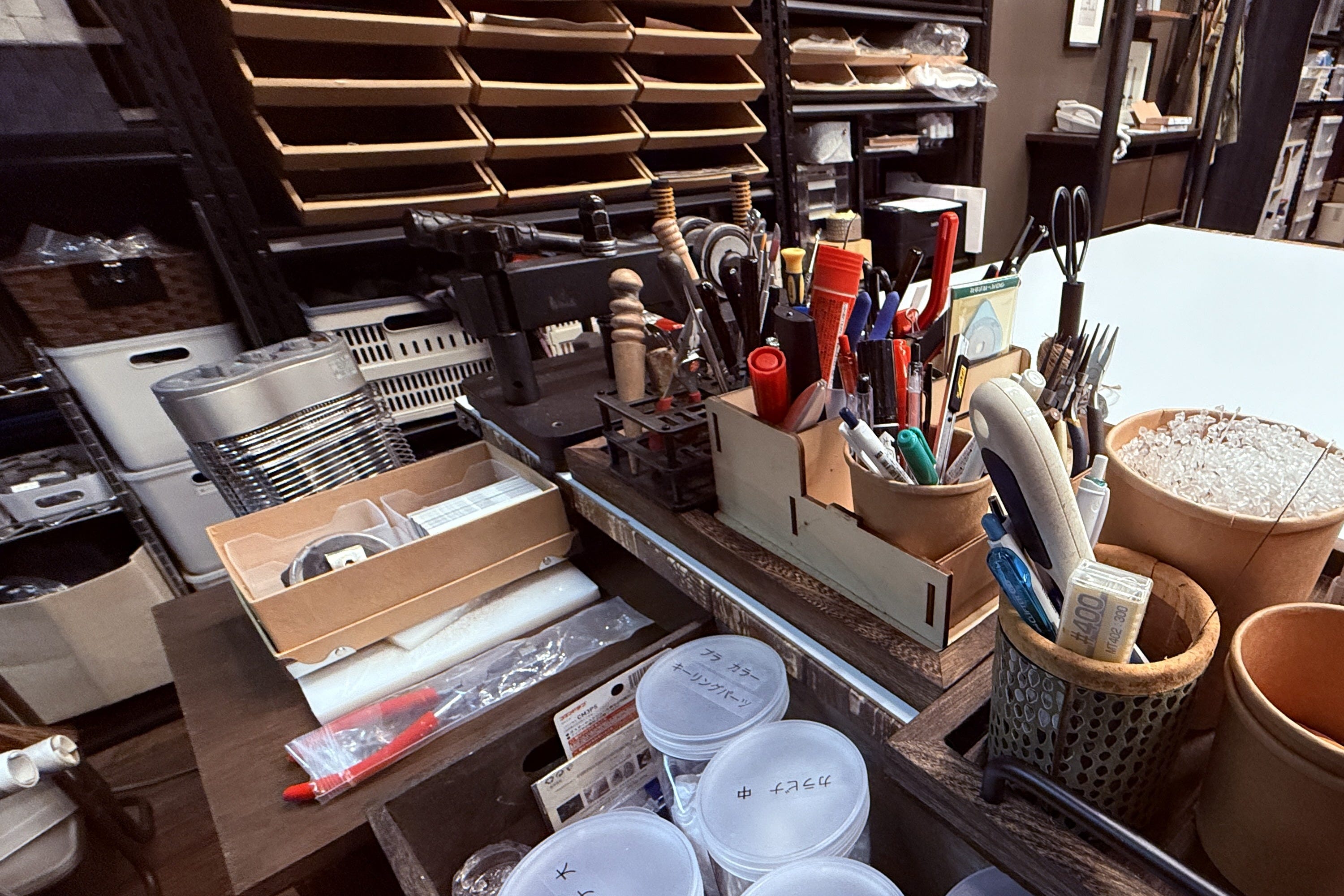
I can make a reasonable list of the things my hands know how to do.
They can sew leather. They can sharpen a blade and keep a straight line with it. They can draw a shape on a screen and coax a 3D printer into producing it, usually before the third attempt. They can write sentences — you can judge for yourself how that’s going.
For most of my life, that list had a clear outer edge, and I never thought much about what lay beyond it. An app was beyond it. Not “difficult.” Beyond. The way flying isn’t on the list of things you consider doing yourself. You just buy a ticket and sit down.
Then I designed a product that needed one.
Grain Patch is a piece of leather. But it doesn’t finish being itself until words go into it, and putting the words in requires software — a small, quiet app, later named Seal. Which meant that for the first time in my life, I had designed something my own hands couldn’t complete.
A leather object, held hostage by code. It’s a strange feeling, standing in your own workroom, being unable to make your own product. I don’t especially recommend it.
The normal answer is: hire someone. And I thought about it. But something in me balked, and it took a while to see what.
This object was about words that don’t pass through other people’s hands. The app was going to be the doorway to it. Sending the doorway out to be built somewhere else felt like — I don’t know — asking a stranger to write the first page of your diary. Nothing wrong with it, exactly. But no.
What happened instead is that I started talking to machines.
Claude Code and Codex, mostly — AI tools that write software while you describe, in ordinary language, what you want. I would explain, in Japanese, the kind of quiet little app I had in mind. Code would appear. Some of it worked. Some of it didn’t, and I would complain, at one in the morning, in Japanese, and the thing would apologize in English and rewrite it.
It was a strange collaboration. I can’t write code. It turns out I can write complaints. That, apparently, was enough.
Makers, as a species, have a well-documented habit.
Put us in front of our own work and we agonize until smoke comes out of our heads — building, breaking, rebuilding, in a loop that from the outside looks like a mild illness. Put us in front of someone else’s work, though, and we become astonishingly eloquent. Sharp, decisive opinions, with no hesitation anywhere in them. I can spend three days failing to choose a thread color for my own piece, then tell another maker in thirty seconds exactly where his piece went wrong. Politely, of course. And with total conviction.
I’ve come to think the difference is responsibility. It sits on your own work like weather. On other people’s work there isn’t any — which does wonders for fluency.
Somewhere in the middle of building Seal, I realized which side of that arrangement I was standing on.
Claude Code wrote the code — so the work, in some strange way, was someone else’s. I would look at what it built, and the sharp, decisive opinions poured out of me, effortless. I’d carry the idea over to Codex, ask whether it could be done better, knead the answer into shape, and bring it back to Claude Code to implement. Around and around like that, for months.
The app would carry my name in the end, so the responsibility was on its way. It just hadn’t arrived yet. And in that strange grace period, I found I could stand all the way back — up where you can see the whole shape of a thing — and simply assemble it. Judging, choosing, directing, with the fluency you normally only get for other people’s work, aimed for once at my own.
I had never made anything that way in my life. As for how much I enjoyed it — I’m still deciding how I feel about that.
I want to be careful here — this is the part that gets overstated everywhere else.
The machines didn’t make Seal for me. Every screen, every word on every button, every decision about what the app would refuse to do — those took months, and they were mine. What the machines did was simpler and stranger: they held the tools I couldn’t hold.
I’ve been through this before, actually. When a 3D printer first came to my workroom, it produced shapes no knife of mine could cut. The printer wasn’t a designer. It was a new pair of hands, wired to the same old head. This felt exactly like that. Nobody in the room but me — just me, with more hands than I was born with.
I am not a programmer now. Let’s be clear about that. My list simply got one line longer: leather, paper, sentences, and — written faintly, in pencil — software.
But without those borrowed hands, there is no Seal. And without Seal, Grain Patch is a nicely shaped piece of leather with nothing to say.
Everything Kyoto Makotoya makes starts from the same line: somewhere along the way, digital things began to press on daily human life, and I decided my replies would take the form of objects. The leather kits and Grain Patch look like different species — one is an owl you assemble with a needle and thread, the other has a chip in it — but they left from the same line.
So there is a smartphone in the middle of Grain Patch, and this is where the story tends to get lost. It looks like a tech product. But the phone is there as a servant, not as the point. I am using digital to do an analog thing: to make a few words stand still and stay.
In Arita, they have been making porcelain for four hundred years. The potters are still there, and the work is still recognizably the work — wheel, glaze, kiln. But at some point the wheel went electric, the glazes quietly acquired materials that didn’t exist a century ago, and nobody declared that Arita ware had stopped being Arita ware. A craft survives by hiring new tools and staying itself. That is what the AI was in this story. My electric wheel. The craft didn’t change. The hands just got newer.
Here is the part I keep returning to, though.
Seal was built out of words. I asked for it in words, complained in words, corrected it in words, and word by word it became real. A tool whose whole purpose is to let a person seal words they trust — and it was itself made of words, spoken half in Japanese, half in English, late at night, between one person and something that isn’t one.
I don’t think that’s a coincidence. I think words were always the material here.
The leather just gives them somewhere to live.
Muneshige Tanigawa / Kyoto Makotoya
もう一組の手
自分の手にできることなら、それなりのリストが書ける。
革を縫える。刃物を研げるし、研いだ刃物でまっすぐな線を保てる。画面の上に形を描いて、3Dプリンターをなだめて出力させることもできる。だいたい三回目までには。文章も書ける——出来のほどは、読んでいるあなたが判断してくれればいい。
人生の大半、このリストにははっきりした外周があって、その外に何があるかを考えたことはあまりなかった。アプリは、外周の外だった。「難しい」ではない。外、なのだ。空を飛ぶことが「自分でやってみようかな」のリストに載らないのと同じで。チケットを買って、座席に座るものだと決まっている。
ところが、それを必要とする商品を設計してしまった。
Grain Patchは革でできている。でも、言葉が入るまでは自分自身になりきらない。そして言葉を入れるにはソフトウェアが要る——のちにSealと名づけられる、小さくて静かなアプリが。つまり僕は、生まれて初めて、自分の手では完成させられないものを設計してしまったわけだ。
コードに人質に取られた、革の物体。自分の作業部屋に立って、自分の商品を作れない、というのは奇妙な気分だ。あまりおすすめしない。
普通の答えは「誰かに頼む」で、実際考えた。でも、どこかが首を縦に振らなかった。理由が見えるまで、少しかかった。
この物体は、他人の手を経由しない言葉の話だった。アプリは、その入口になるものだった。その入口だけをどこかに外注するのは——なんというか、日記の一ページ目を知らない人に書いてもらうようなものだ。何も間違ってはいない。でも、違う。
かわりに起きたのは、機械と話しはじめる、ということだった。
主にClaude CodeとCodex——欲しいものを普通の言葉で説明すると、ソフトウェアを書いてくれるAIの道具だ。僕は日本語で、頭の中にある静かな小さいアプリのことを説明した。コードが現れた。動くものもあった。動かないものもあって、僕は深夜一時に日本語で文句を言い、向こうは英語で謝って書き直した。
奇妙な共同作業だった。僕はコードが書けない。かわりに、文句なら書けることがわかった。どうやら、それで足りたらしい。
作る人間というのは、種族として、よく知られた習性を持っている。
自分の作品の前に置かれると、頭から煙が出るまで悩む。組んでは、壊し、また組む。外から見れば軽い病気に見える種類のループだ。ところが他人の作品の前に置かれると、僕らは驚くほど雄弁になる。シャープで、迷いのかけらもない意見が湧いてくる。僕は自分の作品の糸の色を三日かけて決められないくせに、他人の作品のどこが違うかなら三十秒で言える。礼儀正しく、もちろん。そして完全な確信を持って。
違いは「責任」なんだと思うようになった。責任は、自分の作品の上には天気みたいに居座っている。他人の作品の上には、それがない。そして責任がないと、人はじつに流暢になる。
Sealを作っている途中のどこかで、自分がその仕組みのどちら側に立っているかに気がついた。
コードを書いたのはClaude Codeだ——だからその仕事は、奇妙なことに、他人の作品だった。出来上がったものを眺めると、あのシャープで迷いのない意見が、楽々と湧いてきた。そのアイデアをCodexに持ち込んで、もっと良くできないかと相談し、答えを練り上げて、またClaude Codeに持ち帰って実装してもらう。何か月も、ぐるぐると、その繰り返し。
アプリには最終的に僕の名前が載る。だから責任はこちらに向かっていた。ただ、まだ届いていなかった。その奇妙な猶予期間のあいだ、僕は思いきり後ろに下がることができた——ものの全体が見える高さまで——そして、ただ組み上げた。判断し、選び、指示する。普段は他人の作品にしか使えないあの流暢さを、生まれて初めて、自分の作品に向けて。
あんな作り方をしたのは、人生で初めてだった。あれをどれだけ楽しんでしまったかについては——いまも態度を決めかねている。
ここは慎重に書いておきたい——世間では、たいてい大げさに語られる部分だから。
機械がSealを作ってくれたのではない。どの画面も、どのボタンのどの言葉も、このアプリが「何をしないか」という決定も——何か月もかかったし、全部僕のものだ。機械がやったのは、もっと単純で、もっと奇妙なことだ。僕には握れない道具を、握っていてくれた。
実は、これには覚えがある。3Dプリンターが初めて作業部屋に来たとき、あれは僕のどの刃物にも切れない形を出力した。プリンターはデザイナーではなかった。同じ古い頭につながった、新しい手だった。今回のも、正確にあれだった。部屋には僕しかいない——ただ、生まれつきより手が多いだけの僕が。
僕はいまもプログラマーではない。そこははっきりさせておく。リストが一行だけ長くなった。革、紙、文章、そして——鉛筆で薄く書き足された——ソフトウェア。
でも、あの借り物の手がなければ、Sealはない。Sealがなければ、Grain Patchは、何も言うことのない、形のいい革の板だ。
京都諒屋の商品は、全部が同じ一本の線からスタートしている。いつからか、デジタルが人の暮らしに影を落としはじめた——それに対して僕が必要だと思う返答を、商品というかたちで作る。そういう線だ。革の模型キットとGrain Patchは、別の生き物に見える。片方は針と糸で組み上げるフクロウで、片方にはチップが入っている。でも、出発した線は同じだ。
だからGrain Patchの真ん中にはスマートフォンがいる。そして、話はだいたいここで迷子になる。テック商品に見えるのだ。でも、スマホは使用人であって、主題ではない。僕はアナログなことをするために、デジタルを使っている。数語の言葉を、立ち止まらせて、留めておくために。
有田では、四百年、磁器を作りつづけている。職人はいまもいるし、仕事も——ろくろ、釉薬、窯——見ればそれとわかる仕事のままだ。でも、いつの間にかろくろは電動になり、釉薬には百年前には存在しなかった材料が静かに加わった。そして、有田焼が有田焼でなくなったと宣言した人は、誰もいない。工芸は、新しい道具を雇って、自分のままでいることで生き延びる。この物語のAIは、それだった。僕の電動ろくろ。工芸は変わっていない。手が、新しくなっただけだ。
それで、僕が何度も戻ってくる場所の話をする。
Sealは、言葉でできている。僕は言葉でそれを頼み、言葉で文句を言い、言葉で直してもらい、言葉を重ねるごとにそれは実物になっていった。人が信頼する言葉を封じるための道具が、それ自体、言葉から作られている。半分は日本語、半分は英語で、深夜に、ひとりの人間と、人間ではない何かのあいだで交わされた言葉から。
偶然ではない気がする。ここでは最初から、言葉が素材だったのだ。
革は、その言葉に住所を与えているだけで。
Muneshige Tanigawa / Kyoto Makotoya