
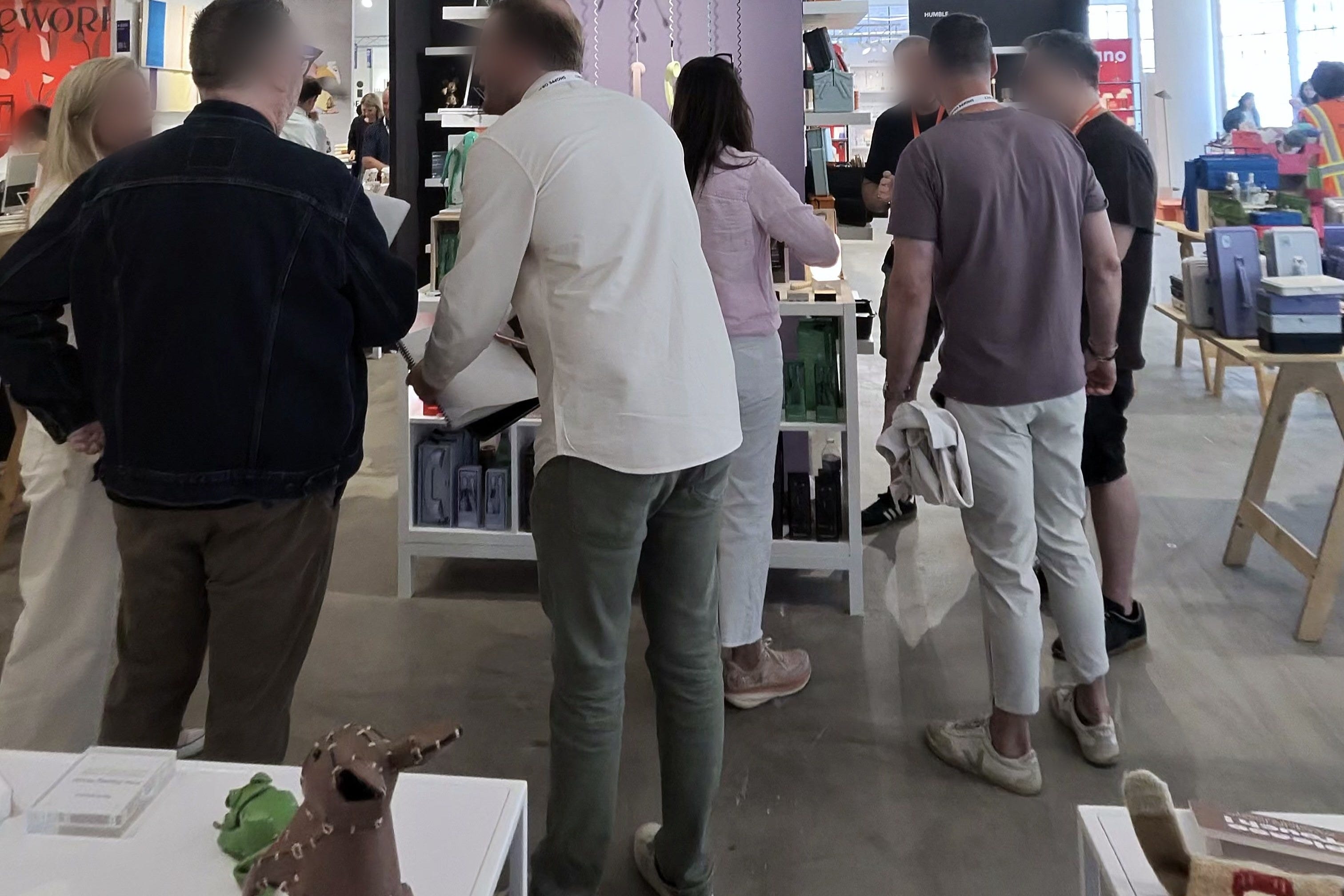
A trade show, seen from inside a booth, is mostly a river. Footsteps, thousands of them, moving at the speed I wrote about last time — eyes sorting the world into categories without ever quite stopping.
Most of the river flows past. Some of it pauses for ten seconds. A little of it stays.
Three weeks later, the river has mostly evaporated from my memory. What remains are two men. Neither stayed longer than a few minutes. I never learned either of their names. And between them, they rearranged more furniture in my head than the rest of the show combined.
The first one was walking fast even by the standards of that aisle.
He slowed, looked at the animals, looked at the patches, and asked two or three questions — good ones, the kind that skip the brochure and go straight for the load-bearing walls. I answered. He nodded.
Then he said, roughly this: “What you’re making is genuinely interesting, and there’s potential in it. But the market —” and here he made a small gesture that seemed to take in the building, the city, possibly the species — “the humans aren’t ready to receive it yet. Give it two or three more years. Keep going.”
And he was gone, before I had decided whether to thank him.
He asked two or three questions and left me two or three years. I assume the numbers matching was a coincidence, though I can’t entirely rule out that he was operating on some private system of exchange rates.
He gave me no business card. He gave me a deadline instead. It has since occurred to me that a deadline lasts much longer than a business card, and takes up less room in the drawer.
After he’d gone, I stood there thinking, of all things, about a scene from Star Wars. You are not ready yet… Luke. Was that Obi-Wan Kenobi? Yoda? Possibly both — lines like that tend to get issued by more than one master. In the middle of a trade-show aisle in Manhattan, I felt like a Padawan who had just been informed he wasn’t ready to become a Jedi Master. Which raised its own questions. What were the requirements for Jedi Master, exactly? Were there any? Who sits on the examining board? These went around and around in my head for a while, accompanied by the famous music.
It took me until much later to notice the part that mattered. You are not ready is not a line that enemies say.
It’s a line that masters say.
Here is the strange accounting of that one minute: being told the world isn’t ready should sound like a rejection. It didn’t.
He hadn’t said the product was wrong. He had said, in effect, that my clock and the world’s clock disagreed — and that his money was on the clocks eventually agreeing. From a stranger in a hurry, with no reason to be kind, that isn’t a door closing. That’s a man leaning in through a window he was under no obligation to open at all.
I was, honestly, encouraged. I still am.
The second man arrived by accident.
He ran a shop of his own, and he had come to our shared stand to place an order with one of the other exhibitors. Business concluded, he drifted sideways — the way people drift in bookshops — and stopped at my table.
By the second day, I should mention, my explanation had been polished into something close to a rakugo routine. There was an opening, a build, a reveal. I knew where people smiled and where they reached for the patch. I took a small breath and prepared to begin.
He began first.
Not with a question — with the explanation. My explanation. He wanted to check his own understanding, he said, and then he laid it out: that the boxes on the wall were not finished figures but kits, and why a kit — the evenings, the needle, the slowness — was the whole point. That the leather patch held words you chose yourself. That nothing showed on the surface. That the object was a way of wearing them.
I stood there and listened to my own products being presented to me, accurately, in somebody else’s words.
A maker explains his work thousands of times in a life. The number of times he gets to hear it explained back is considerably smaller. I don’t know what the correct facial expression for that situation is. Whatever it is, I doubt I produced it.
His version was, if anything, slightly better organized than mine. I decided not to tell him that.
Afterward, I kept turning over the difference between the two kinds of people who had stood at my table that week.
The man who explained my product to me owns his shop. The money he spends on a wrong guess is his own. And I remembered something I wrote in an earlier letter — that responsibility does wonders for fluency. It turns out it does wonders for comprehension too. A person betting their own money learns to read a strange object quickly, all the way to the bottom. A person spending somebody else’s rides a carousel horse: handsome, in constant motion, and fixed to its orbit. It passes the same scenery at the same distance on every circuit, and stopping for something outside the rail was never part of the mechanism.
I don’t offer that as a complaint about anyone. It’s only that I had never seen the difference standing in front of me in physical form, twice in one week, wearing different shoes.
And somewhere between those two visitors — quietly, over three days of holding my own product out to strangers — I arrived at a verdict I had not packed for this trip.
Grain Patch was not ready.
It could be sold. I want to be precise about this: people would have bought it, and nothing about it is broken. But demonstrating something forty times a day is a kind of mirror, and in that mirror I could see all the small places where the object still needs work. The patch, for example, holds on to leather and canvas with conviction — but on slick nylon it is prone to changing its mind partway through the trip. Small things. Fixable things. But real ones.
And one large thing, which has nothing to do with glue. The idea at the center — wearing words — does not yet cross a noisy room on its own. That is not the room’s failure. It’s a translation that nobody has designed yet.
The hurried man said the humans need two or three years. Standing there on the last afternoon, I found I agreed with his number. I just think some of those years are addressed to me.
What I did with all of this — and what a city with all its downtown subway entrances locked taught me about speed, late one sweaty night — that’s the last part. Next time.
Muneshige Tanigawa / Kyoto Makotoya
二人の来場者
ブースの内側から見る展示会というのは、だいたいのところ、川だ。何千という足音が、前回書いたあの速度で流れていく。目は世界をカテゴリーに仕分けながら、決して完全には止まらない。
川のほとんどは、流れ過ぎていく。一部は、十秒だけ止まる。ごく一部が、留まる。
三週間たって、川の記憶はあらかた蒸発した。残っているのは、二人の男だ。どちらも、数分しか立ち止まらなかった。どちらの名前も、僕は知らない。そしてこの二人は、展示会の残り全部を合わせたよりも多くの家具を、僕の頭の中で並べ替えていった。
一人目は、あの通路の基準に照らしても、速く歩いていた。
彼は速度を落とし、動物たちを見て、パッチを見て、二つ三つ質問をした——良い質問だった。パンフレットを飛ばして、いきなり柱に手をかける種類の質問だ。僕は答えた。彼は頷いた。
それから、だいたいこう言った。「君の作っているものは、非常に興味深いし、ポテンシャルもある。ただ、マーケットが——」ここで彼は、建物と、街と、おそらくは人類までを含むような小さな身振りをした——「人間のほうに、それを受け入れる用意がまだ出来ていない。あと二、三年、がんばって続けたまえ」。
そして、僕が礼を言うべきかどうか決める前に、いなくなった。
彼は二、三の質問をして、二、三年を置いていった。数が揃っていたのは偶然だと思う。ただ、彼が何か個人的な為替レートで動いていた可能性も、完全には否定できない。
名刺はくれなかった。かわりに、締切をくれた。あとになって気づいたのだが、締切は名刺よりずっと長持ちするし、引き出しの場所も取らない。
彼が去ったあと、僕はその場に立ったまま、よりによってスターウォーズのワンシーンを思い出していた。You are not ready yet… Luke. オビ=ワン・ケノービだったか。ヨーダだったか。もしかすると、二人とも言ったのかもしれない。ああいう台詞は、だいたい複数の師匠から発行されることになっている。マンハッタンの展示会の通路の真ん中で、僕は、ジェダイ・マスターになる準備がまだ出来ていないと告げられたパダワンのような気分で立っていた。すると、別の問いが湧いてくる。そもそもジェダイ・マスターになる条件とは、何だったのか。そんなものは、あったのか。審査は誰がするのか。そういう問いが、例の有名な音楽と一緒に、頭の中をしばらくぐるぐる回っていた。
大事な部分に気づいたのは、ずいぶん経ってからだ。You are not ready は、敵の言う台詞ではない。
あれは、師匠の言う台詞だ。
あの一分間の奇妙な帳簿の話をする。「世界に受け入れる用意がない」と言われるのは、断り文句に聞こえるはずだ。聞こえなかった。
彼は、商品が間違っているとは言わなかった。言ったのは、要するに、僕の時計と世界の時計がずれている、ということだ。そして彼は、時計がいずれ合うほうに賭けていた。急いでいて、親切にする義理もない見知らぬ人からのそれは、扉が閉まる音ではない。開ける義務のなかった窓から、わざわざ身を乗り出してくれた男だ。
正直に言えば、勇気づけられた。いまも、そうだ。
二人目は、偶然やってきた。
自分の店を経営している人で、僕らの共同スタンドには、別の出展者に発注をするために来ていた。用事が済むと、彼は横に流れてきた——本屋で人が流れるあの流れ方で——そして、僕の机の前で止まった。
言っておくと、二日目までに、僕の説明は落語の演目に近いところまで磨き上がっていた。枕があり、山場があり、サゲがあった。どこで人が微笑み、どこでパッチに手を伸ばすか、僕は知っていた。僕は小さく息を吸って、始める準備をした。
彼のほうが先に始めた。
質問ではなく——説明を、だ。僕の説明を。自分の理解が正しいか確かめたい、と彼は言って、それから並べてみせた。壁の箱は完成品ではなくキットであること。なぜキットなのか——夜の時間、針、遅さ——それこそが要点であること。革のパッチには自分で選んだ言葉が入ること。表面には何も見えないこと。あれは、言葉を纏うための物体であること。
僕はそこに立って、自分の商品が、他人の言葉で、正確に、僕に向かってプレゼンされるのを聞いていた。
作り手は、一生のうちに何千回も自分の仕事を説明する。それを聞かせてもらえる回数は、かなり少ない。ああいう場面の正しい表情がどんなものか、僕は知らない。何であれ、僕がそれを作れていたとは思えない。
彼の説明は、どちらかと言えば、僕のものより少し整理されていた。それは言わないことにした。
そのあと僕は、あの週、僕の机の前に立った二種類の人間の違いを、何度も転がしつづけた。
僕の商品を僕に説明した男は、自分の店の持ち主だ。読み違えたときに減るのは、自分のお金だ。そして、前の手紙に書いたことを思い出した——責任がないと、人はじつに流暢になる、というあれだ。どうやら責任は、理解のほうにも同じくらい効くらしい。自分のお金を賭ける人間は、見知らぬ物体を、底まで速く読めるようになる。他人のお金を使う人間は、メリーゴーランドの馬に乗っている。立派で、よく動くが、軌道は最初から決まっている。同じ景色のそばを、同じ距離で、一周ごとに通り過ぎる。柵の外にあるもののために止まることは、あの仕組みには、もともと含まれていない。
誰かへの文句として言っているのではない。ただ、あの違いが物理的な形をとって、同じ週に二度、違う靴を履いて目の前に立ったのを、僕は初めて見たのだ。
そして、その二人のあいだのどこかで——三日間、自分の商品を見知らぬ人に差し出しつづけるうちに、静かに——僕は、この旅の荷物には入れてこなかった結論に辿り着いた。
Grain Patchは、まだ出来ていなかった。
売ることはできた。ここは正確に書いておきたい。買ってくれる人はいただろうし、壊れているところはどこにもない。でも、一日に四十回も実演するというのは一種の鏡で、その鏡の中に、この物体にまだ手が必要な小さい場所が、全部映っていた。たとえばパッチは、革やキャンバスには確信を持ってしがみつくのに、つるつるしたナイロンの上では、旅の途中で心変わりをしやすい。小さいこと。直せること。でも、本当のことだ。
そして、接着剤とは関係のない、大きいことがひとつ。中心にある考え——言葉を纏う——は、まだ、騒がしい部屋を自力で渡れない。それは部屋の落ち度ではない。まだ誰も設計していない、翻訳なのだ。
急ぎ足の男は、人間にはあと二、三年必要だと言った。最終日の午後、そこに立ちながら、僕はあの数字に同意していることに気がついた。ただ、あの年月の何年かは、僕宛てなのだと思う。
これをぜんぶ持ってどうしたか——そして、ダウンタウン行きの地下鉄の入口がぜんぶ施錠された街が、汗だくの夜に速度について教えてくれたこと——それが最終回。次回。
Muneshige Tanigawa / Kyoto Makotoya