There is a question every model kit maker should be forced to answer, and it has nothing to do with assembly.
What happens to the thing after it’s finished?
I knew the honest answer from my own shelves. The finished model goes up there, is admired for a week, and then enters a long, dignified retirement. It gets taken down roughly once a year, at the year-end cleaning, for the removal of dust. That is its entire schedule of engagements.
I had spent all this effort designing the making — and the made thing, the moment it was done, became unemployed.
So every animal in our zoo comes with a job. In Japan this employment system has existed for centuries; it’s called engi — the quiet assignment of luck to living things. An animal on a shelf with a job is no longer a dust collector. It’s on duty.
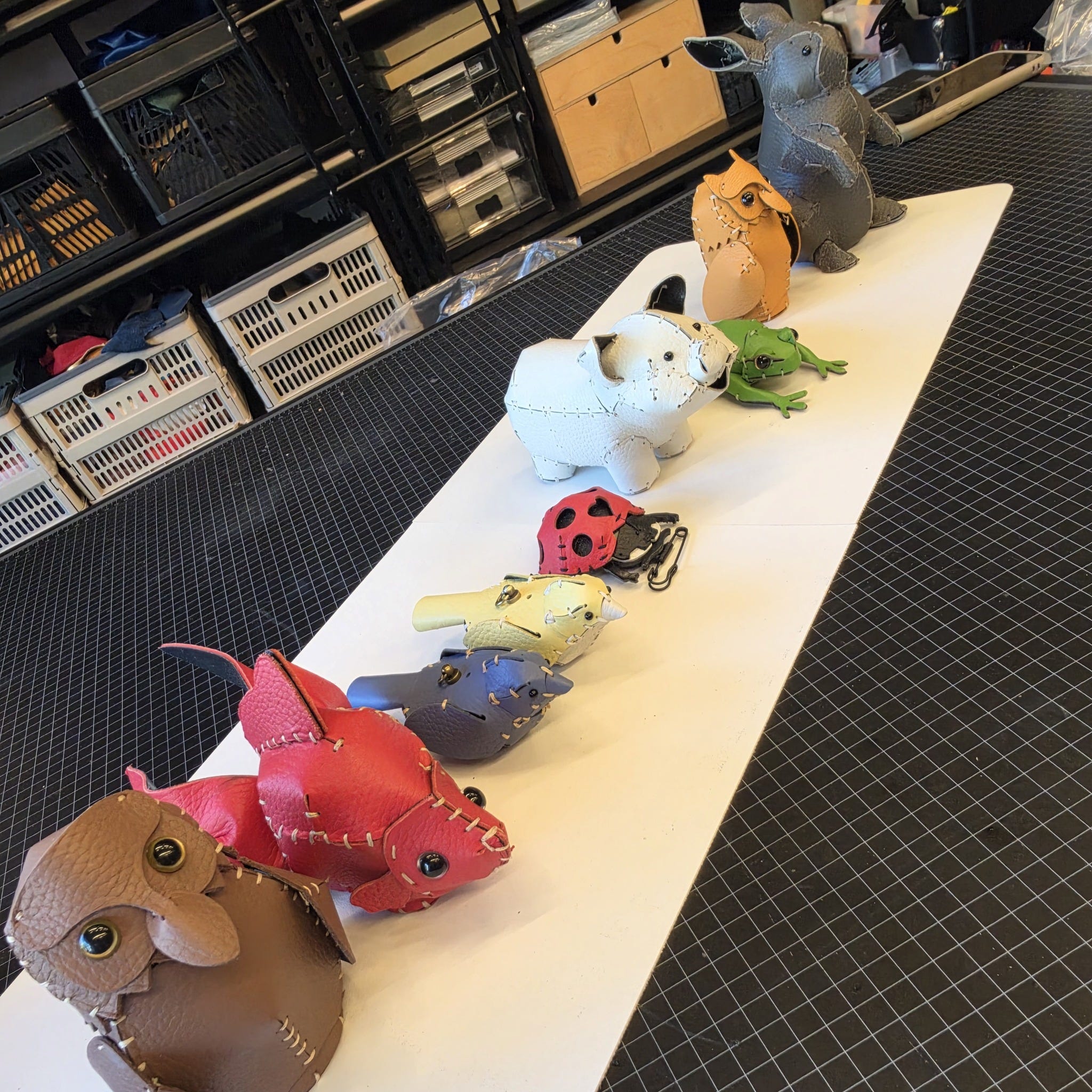
What follows is the staff roster, in order of hiring.
The Owl came first, and the owl had the hardest time of it — which is ironic, because in Japanese the owl, fukurou, can be written to mean “no hardship.”
Why an owl at all, I wrote about long ago: a symbol legible in almost every country, wisdom in the West, folded fortune in Japan, the right icon to stand at the front of a series. What I didn’t write then is that the first animal isn’t really an animal. It’s a constitution. Before the owl could exist, the box had to be given its minimum size; the box then dictated the largest possible part; the largest part dictated how many parts a completed animal could afford. Every animal that came after has lived inside laws the owl wrote.
The owl carries no hardship, and wrote the rules. Founders usually get it the other way around.
The Goldfish came second, and the goldfish was a rebellion.
The owl had proven the kit could exist. The goldfish asked what leather could do that plastic never could — and the answer turned out to be verbs: pinch, twist, fold. Plastic snaps together. It does not fold. A goldfish’s fins and tail are nothing but folds — a fish that is half origami, possible only in a material that bends without breaking and forgives you afterward.
In Japanese, kingyo carries “gold” in its name, and the fish has meant wealth and abundance for a very long time. It seemed right that the richest assembly vocabulary in the series went to the fish named after money.
The Little Bird and the Ladybird arrived as a pair, and they are the zoo’s answer to a different problem: the front door.
Not everyone wants an eighteen-part project on the first evening. The minis carry fewer parts and a lower threshold, but the balance had to be exact — reduce the parts too far and you remove the satisfaction along with the difficulty, and the front door opens onto nothing. Getting “small but still an achievement” right took more tries than I’d like to admit.
The bird’s job is happiness and new beginnings. The ladybird’s is good luck and happy news. Entry-level positions, perhaps. But every zoo needs greeters.
The Pig is where the zoo learned to leave something undone.
A pig, worldwide, means saved-up wealth — the piggy bank is one of the few objects that needs no translation anywhere. So our pig can become one. But the coin slot on its back, you cut yourself.
This wasn’t laziness. Coins are different sizes in every country — a slot cut in Kyoto would fit a 500-yen coin and reject a euro. So the kit stops one step short of finished and hands you the knife: measure your own currency, open your own slot. The pig crosses the border unfinished on purpose, and becomes local the moment you wound it.
I am quietly very proud of that hole.
The Frog returns to the mini series, but the frog had a stricter brief: with a handful of parts, it had to be unmistakably, undeniably a frog — no squinting, no explanation. Compression without loss.
Its luck is the best wordplay in the building. Kaeru: the frog, but also “to return.” Money returns. Travelers return safely. And a frog, anatomically, only ever jumps forward. An animal that guarantees returns while refusing to go backward — if a frog walked into a bank, they’d make it a fund manager on the spot.
The Rabbit is the newest hire, and the most difficult kit we have ever made.
Everything the goldfish discovered — the pinching, the twisting, the leather-only verbs — the rabbit inherited and pushed further, into long curves and compound twists, ears that have to stand up on their own convictions. Eighteen parts, each one starting flat and finding its body through thread. If the owl wrote the constitution and the goldfish found the language, the rabbit is the first long novel.
Its job: the leap. A rabbit only bounds forward, and in Japan it lives on the moon, and tsuki — moon — sounds like luck. An animal for beginnings, for advancement, for jumping farther than looks reasonable.
It seemed fitting to give the hardest climb in the series to the animal in charge of leaps.
Seven jobs, then: no hardship, wealth, happiness, good news, safe returns, savings, and the leap. A small civil service of luck, stationed on shelves in whatever rooms they’ve ended up in, doing their quiet work between one year-end dusting and the next.
There is a line we print as the brand’s official position, and I’ll let it close the tour, because five words say what this whole letter has been circling:
You don’t buy luck. You make it.
Stitch by stitch, as it happens. With your own hands. The animals just hold the post afterward.
Muneshige Tanigawa / Kyoto Makotoya
小さな動物園、登場順
模型キットの作り手が全員、答えを強制されるべき質問がひとつある。組み立てとは何の関係もない質問だ。
完成したあと、それはどうなるのか?
正直な答えなら、自分の棚が知っていた。完成した模型は棚に上がり、一週間ほど鑑賞され、それから長く尊厳ある隠居生活に入る。取り出されるのは年に一度、年末の大掃除で、埃を払われるとき。それが、彼の全スケジュールだ。
作る過程の設計にこれだけの手間をかけておいて——作られた物は、完成した瞬間に、無職になっていた。
だから、うちの動物園の動物には、全員に仕事がある。日本にはこの雇用制度が何世紀も前からあって、縁起と呼ばれている。生き物に運の担当を静かに割り振る仕組みだ。仕事を持って棚に立つ動物は、もう埃を集める置物ではない。勤務中なのだ。
以下、採用順の職員名簿である。
フクロウが最初に来た。そして最初のフクロウが、いちばん苦労した——皮肉な話だ。日本語でフクロウは「不苦労」と書けるのに。
そもそもなぜフクロウだったのかは、ずっと前に書いた。ほとんどの国で意味の通じる象徴であること。西洋では知恵、日本では折り畳まれた福。シリーズの先頭に立つ顔として正しかったこと。あのとき書かなかったのは、一体目の動物は、実は動物ではないということだ。あれは憲法だった。フクロウが存在できるようになる前に、まず箱に最小サイズが与えられ、箱がパーツの最大寸法を決め、最大寸法が、一体の動物に許されるパーツ数を決めた。あとに続いたすべての動物は、フクロウの書いた法律の中で生きている。
苦労を持たない鳥が、規則を書いた。創業者というのは普通、逆の目に遭うものだが。
金魚は二番目に来た。そして金魚は、反乱だった。
フクロウは、キットが存在できることを証明した。金魚は、革にできてプラスチックに決してできないことは何か、と問うた。答えは動詞の形をしていた。つまむ。捻る。畳む。プラスチックはパチンと嵌まる。でも、畳めない。金魚のヒレと尾は、畳み以外の何ものでもない——半分折り紙でできた魚。曲げても割れず、あとで赦してくれる素材でだけ、可能になる魚だ。
金魚は名前の中に「金」を運んでいて、ずっと昔から富と豊かさを意味してきた。シリーズでいちばん豊かな組み立ての語彙が、お金の名前を持つ魚のところへ行ったのは、正しかったと思う。
小鳥とテントウムシは、対で来た。この二匹は、別の問題への答えだ。玄関の問題である。
誰もが最初の晩から18パーツの工事をやりたいわけではない。ミニキットはパーツが少なく、敷居が低い。ただ、この釣り合いは正確でなければならなかった。パーツを減らしすぎると、難しさと一緒に達成感まで取り除いてしまい、玄関を開けたら何もない、ということになる。「小さいが、ちゃんと達成である」の一点に合わせるのは、認めたくない回数の試作を要した。
小鳥の担当は、幸せと新しい始まり。テントウムシの担当は、幸運と良い知らせ。入門職と言えばそうかもしれない。でも、どんな動物園にも、入口係は要るのだ。
子豚は、動物園が「やり残す」ことを覚えた場所だ。
豚は世界中で、貯めた富を意味する。豚の貯金箱は、地球上のどこでも翻訳の要らない数少ない物のひとつだ。だから、うちの子豚は貯金箱になれる。ただし、背中のコイン投入口は、あなたが自分で切る。
手抜きではない。コインの寸法は国ごとに違う。京都で開けた穴は、500円玉を通してユーロを弾く。だからキットは完成の一歩手前で止まって、あなたに刃物を手渡す。自分の国の通貨を測り、自分の穴を開けてほしい、と。子豚はわざと未完成のまま国境を越えて、あなたが傷をつけた瞬間に、その国の住人になる。
僕はあの穴を、静かに、かなり誇りに思っている。
カエルでミニシリーズに話は戻るが、カエルにはより厳しい要求書が渡された。ひと握りのパーツで、誰が見ても、疑いようもなくカエルであること。目を細めなくていい。説明も要らない。損失なしの圧縮。
そして彼の縁起は、この建物で最高の言葉遊びだ。カエル——蛙であり、「帰る」「返る」でもある。お金が返ってくる。旅人が無事に帰ってくる。しかも蛙は、身体の構造上、前にしか跳べない。後退を拒否しながらリターンを保証する動物——カエルが銀行に歩いて入ったら、その場でファンドマネージャーに採用されるだろう。
うさぎは最新の採用で、うちがこれまでに作った中で、最も難しいキットだ。
金魚が発見したすべて——つまみ、捻り、革だけの動詞たち——を、うさぎは相続して、さらに先へ押し進めた。長い曲線へ。複合的な捻りへ。自分の信念で立っていなければならない、二本の耳へ。18のパーツが、一枚ずつ平らな状態から始まって、糸を通して身体を見つけていく。フクロウが憲法を書き、金魚が言語を見つけたのだとしたら、うさぎは最初の長編小説だ。
担当は、跳躍。うさぎは前にしか跳ばず、日本では月に住んでいて、月は「ツキ」と読める。始まりのための、前進のための、見た目より遠くまで跳ぶための動物。
シリーズでいちばん険しい登り道を、跳躍の担当者に任せたのは、似合いの人事だったと思う。
というわけで、七つの職掌が揃った。不苦労、金運、幸せ、良い知らせ、無事の帰還、貯蓄、そして跳躍。運の小さな公務員団が、いまごろ、それぞれの部屋の棚に配属されて、年末の埃払いから次の埃払いまでのあいだ、静かに勤務している。
ブランドの公式見解として印刷している一行があって、この見学ツアーの締めはそれに譲ろうと思う。この手紙がぐるぐる回りながら言おうとしてきたことを、五つの単語が言ってしまっているからだ。
You don’t buy luck. You make it.
運は買うものではなく、作るもの。実際のところ、ひと針ずつ。あなた自身の手で。動物たちはそのあと、持ち場に立っているだけだ。
Muneshige Tanigawa / Kyoto Makotoya