
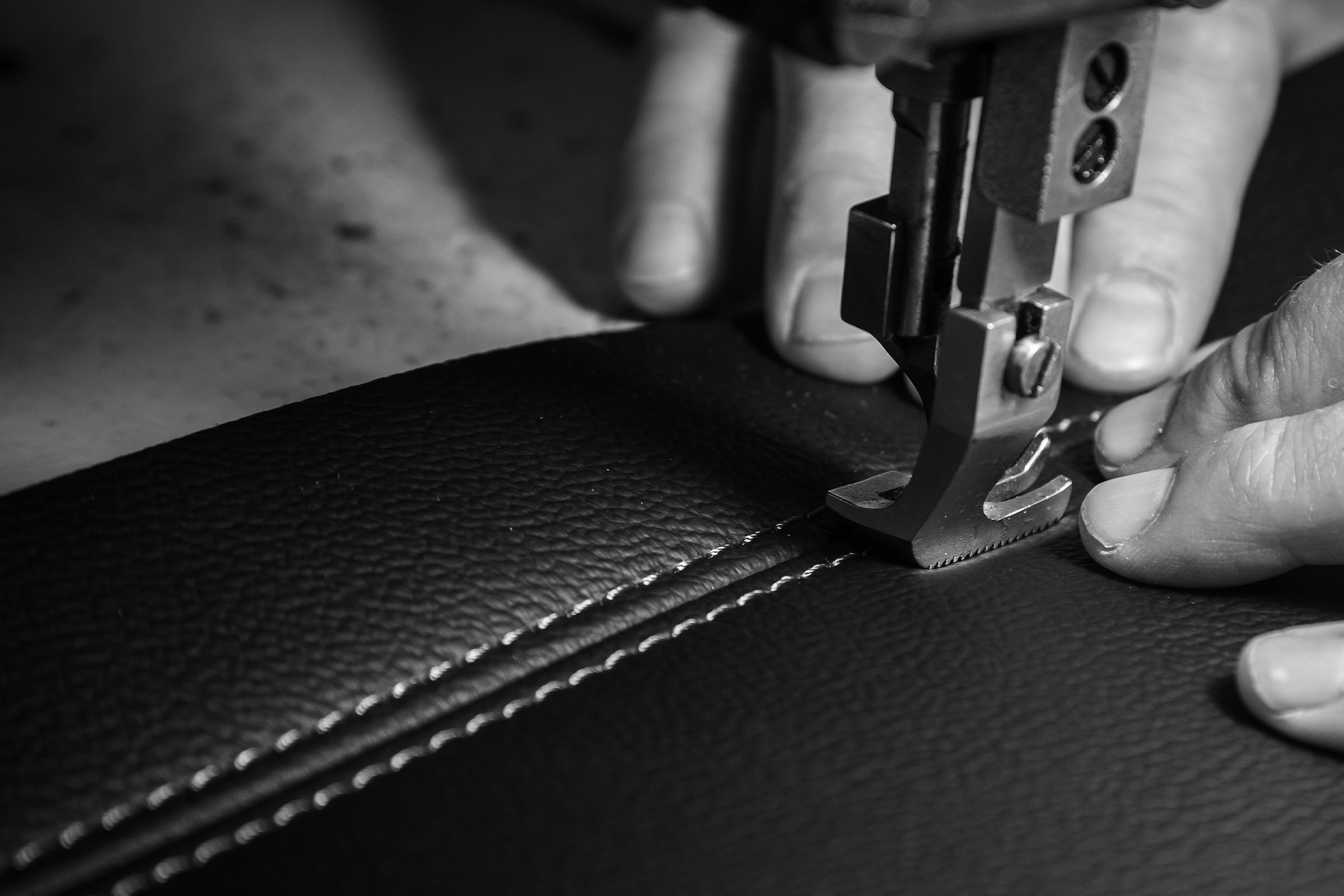
At the university where I teach, my course is built on one constant: the students make works using fabric. Around that constant, the theme changes every year — I set a new one each spring and hand it to them. Last year’s theme was Echo. This year’s was a single word: Trace.
Most of the students who take it have never touched a sewing machine — or touched one exactly once, years ago, in a home economics room, the way you might once have shaken hands with a stranger at a wedding. By the end of the term they have designed something, fought a machine for it, and stood in front of the class holding the result. It is, I’m told, one of the heavier electives on offer. I keep it that way on purpose, but that’s a story I’ve partly told before.
What I want to write about today is a number I hand the students at the end of every term, and what it did to me when I first looked it up.
Human beings have been sewing for roughly sixty thousand years.
Sit with that figure for a moment, because it refuses to stay abstract. Sixty thousand years is older than agriculture. Older than the wheel, older than pottery, older by tens of millennia than writing. When the first needle went through the first hide, there were no cities to wear the result in. Sewing is not one of civilization’s inventions. It’s one of the things civilization was built on top of — right down at the bottom of the stack, next to fire and cooking and not much else.
We think of the needle as a humble object. The needle was there before almost everything that now looks down on it.
The sewing machine, by contrast, is barely two hundred years old, and it is one of the more complicated machines humans have put in ordinary homes. The modern ones carry computers inside. They embroider, they buttonhole, they offer you two hundred stitch patterns through a touchscreen.
And yet at the center of every one of them, from the treadle machines of the nineteenth century to the computerized ones in this year’s catalog, sits the same single, stubborn function: sew a straight line.
Anyone who has taken my course can tell you the joke hiding in that sentence. The straight line is the whole difficulty. Students discover this in their bodies, in week one — the fabric drifts, the line wanders, the machine that promised straightness turns out to only supply half the bargain. Two hundred years of engineering, and the machine still leaves the hard part to you.
Here is the thought that stopped me, though, when I first put the number and the craft side by side.
In my lifetime, AI systems finished their analysis of the game of Go — a game people had assumed was bottomless. It turned out to have a floor after all; the machines simply reached it first, and the world made a great deal of noise about this.
Sewing had the same thing happen to it, almost silently, without a single processor involved. Sixty thousand years of human beings, each solving their corner of the same problem — how to join soft material so it holds, so it moves, so it lasts — amounts to an analysis so thorough that the territory is, for most practical purposes, mapped. Whatever you are trying to do with cloth or leather, somebody, somewhere, in some century, has already met your exact problem and left a solution behind.
Every one of those solutions is sleeping in a drawer somewhere — in a book, in a surviving garment, in the fingers of a tradition. Sixty thousand years of drawers. I think of it as one very long shelf.
If you make things, this shelf is the best news available.
It means you are never actually stuck. The answer to your problem exists; the question is only whether you can find the drawer. Our kits lean on that shelf constantly and without embarrassment — the saddle stitch our owls are built with was old when cathedrals were new, and the idea of punching holes before sewing leather belongs to no one because it has belonged to everyone for centuries. When I said the kits were designed, I should have been more precise: a great deal of them was retrieved.
But the shelf has a sting in it, and I tell my students about the sting, because it’s the part worth keeping.
At some point you will struggle with a problem for three days, solve it your own way, feel the specific glow of having invented something — and then, a week later, in an old book or an old jacket, you will meet your invention, executed better, by someone who died long before you were born. There is a particular feeling that arrives at that moment. It is not quite disappointment. It’s closer to being quietly outnumbered.
I’ve come to believe that small bitter feeling is one of the most valuable things a maker can own. It is the proof that you worked far enough into the territory to reach where the masters got. And it does something else, too.
It makes you want to open the next drawer.
The assignment I handed out this spring used Trace in a specific sense: the marks that use leaves in a material — the way denim fades and creases, over a wearer’s years, into a record of one particular life. That was the brief. But the word refused to stay inside it. As the term went on, trace kept widening in my head, until by summer it had reached all the way back — because sixty thousand years of sewing is itself one long trace. Not a technique. An unbroken line of marks left by hands, each one saying: I was here, this worked, take it.
A seam, if you think about it, is the most honest signature there is. It can’t be forged quickly. It shows its maker’s patience, hesitation and nerve, stitch by stitch, to anyone who looks closely. The shelf is sixty thousand years of such signatures.
What I hope — for my students, and for anyone who spends a few evenings with one of our animals — is modest, as hopes on this shelf go.
One more stitch on the end of the line. Slightly crooked is fine.
The straight part, as we’ve established, was never the machine’s to give anyway.
Muneshige Tanigawa / Kyoto Makotoya
六万年の棚
僕が教えている大学の講座には、ひとつの変わらない根幹がある。学生たちが、布を使って作品を作ること。その根幹のまわりで、テーマだけが毎年変わる。春になると、僕が新しいテーマをひとつ掲げて、学生たちに手渡すのだ。去年のテーマは「Echo」——反響、共鳴。今年のテーマは、ひと言だった。「痕跡」。
受講する学生のほとんどは、ミシンに触ったことがない——あるいは、何年も前に家庭科室で一度だけ触った。結婚式で見知らぬ人と一度だけ握手した、というのに近い触り方で。学期が終わる頃には、彼らは何かを設計し、そのために機械と格闘し、結果を手に持って教室の前に立っている。負荷の高い選択課題として知られているらしい。わざとそうしてあるのだが、その話は以前に半分書いた。
今日書きたいのは、毎学期の終わりに学生へ手渡している、ひとつの数字のことだ。そして、最初にそれを調べたとき、僕に何が起きたかについて。
人類は、およそ六万年前から縫っている。
この数字と、少しのあいだ一緒に座っていてほしい。抽象のままでいることを拒否する数字だから。六万年は、農耕より古い。車輪より古く、土器より古く、文字より数万年も古い。最初の針が最初の獣皮を通ったとき、縫い上がったものを着ていく街は、まだどこにもなかった。縫うことは、文明の発明品のひとつではない。文明がその上に建てられた土台のほうだ——スタックのいちばん底、火と料理の隣に、他にはほとんど何もない場所に。
僕らは針を、つつましい道具だと思っている。針は、いま針を見下ろしているほとんどすべてのものより、先にそこにいた。
一方、ミシンはたかだか二百年ほどの機械で、それでいて、人類が家庭に持ち込んだ機械の中ではかなり複雑な部類に入る。いまのミシンはコンピューターを内蔵している。刺繍をし、ボタンホールを作り、タッチパネル越しに二百種類のステッチを提案してくる。
それでも、そのすべての中心には——十九世紀の足踏みミシンから今年のカタログのコンピューターミシンまで——同じひとつの頑固な機能が座っている。まっすぐ縫う、である。
僕の講座を取った人なら、この文に隠れている冗談を指させる。そのまっすぐこそが、難しさの全部なのだ。学生たちは第一週に、身体でこれを発見する。布は流れ、線はさまよい、まっすぐを約束したはずの機械は、実は取引の半分しか履行してくれないと判明する。二百年の工学をもってしても、機械はいまだに、難しいほうの半分をこちらに任せている。
ただ、数字と工芸を並べて置いたとき、僕の手を止めたのは、こういう考えだった。
僕が生きているあいだに、AIが囲碁というゲームの解析をあらかた終えてしまった。底なしだと思われていたゲームに、実は底があって、機械が先にそこへ着いた。世界はこの件で、ずいぶん大きな音を立てた。
縫うことにも、同じことが起きていた。ほとんど無音で、プロセッサを一枚も使わずに。六万年ぶんの人間たちが、それぞれの持ち場で同じ問題を解きつづけた——柔らかい素材を、保つように、動くように、長持ちするように繋ぐには、どうすればいいか。その蓄積は、実用上ほぼ全域が地図化された、と言っていいほど徹底した解析になっている。布や革でやりたいことが何であれ、誰かが、どこかで、いつかの世紀に、あなたとまったく同じ問題に出会って、解決を残していったのだ。
そのすべての解決が、いまもどこかの引き出しで眠っている。本の中で。生き残った衣服の中で。伝統を受け継いだ誰かの指の中で。六万年ぶんの引き出し。僕はそれを、一本のとても長い棚として思い浮かべている。
ものを作る人間にとって、この棚は、手に入る中で最良の知らせだ。
つまり、あなたは実際には、決して行き詰まらない。あなたの問題の答えは存在している。問題はただ、その引き出しを見つけられるかどうかだけだ。うちのキットは、この棚に常時、堂々と寄りかかっている。フクロウたちを組み上げているサドルステッチは、大聖堂が新築だった頃にはもう古い技術だったし、革を縫う前に穴を開けておくという発想は、誰のものでもない——何世紀ものあいだ、全員のものだったからだ。キットを設計した、と僕は言ってきたが、正確を期すべきだった。かなりの部分は、設計ではなく引き出しから回収された。
ただ、この棚にはひとつ棘があって、僕は学生たちにその棘の話をする。そこが、持ち帰る価値のある部分だからだ。
いつか必ず、こういうことが起きる。ある問題に三日間苦しんで、自分のやり方で解いて、何かを発明したときの独特の火照りを感じる——そして一週間後、古い本の中か、古い上着の中で、自分の発明に出会う。もっと上手に実行されたそれに。あなたが生まれるずっと前に死んだ誰かの手で。あの瞬間にやってくる感情には、固有の手触りがある。落胆とは少し違う。静かに多勢に無勢である、というのに近い。
僕は、あの小さな苦い感情こそ、作り手が持てる最も価値あるもののひとつだと考えるようになった。あれは、名人たちの到達点まで自力で歩いた者にだけ発行される証明書だ。そしてあの感情には、もうひとつ働きがある。
次の引き出しを、開けたくさせるのだ。
この春に配った課題文の中で、「痕跡」は特定の意味で使われていた。使われることで素材に残る印——デニムが色落ちし、皺を刻んで、着る人の歳月とともに、ひとつの人生の記録へ変わっていくような。それが出題だった。ただ、この言葉は出題の中に留まっていてくれなかった。学期が進むにつれて、「痕跡」は僕の頭の中で勝手に広がりつづけ、夏になる頃には、いちばん遠いところまで届いてしまっていた——六万年の縫うことそれ自体が、一本の長い痕跡なのだ。技術ではなく、手が残していった途切れない印の列。ひとつひとつが、こう言っている。ここにいた。これは効いた。持っていけ。
縫い目というのは、考えてみれば、この世で最も正直な署名だ。手早くは偽造できない。作った人の忍耐と、迷いと、思い切りを、一針ずつ、よく見る人になら全部見せてしまう。あの棚は、そういう署名の六万年ぶんだ。
僕の願いは——学生たちにも、うちの動物と何日かの夜を過ごしてくれる人にも——この棚の上の願いとしては、つつましいものだ。
列のいちばん端に、もう一針。少し曲がっていて、かまわない。
まっすぐのほうは、先に確認した通り、もともと機械にも渡せなかったのだから。
Muneshige Tanigawa / Kyoto Makotoya