
Last time, I ended with a decision: to design a kit in which a person could really fail — feel it, learn from it — without bleeding for it.
The first question was material, and the honest answer is that the material chose itself. My company sells natural leather and manufactures leather goods; a coffee shop does not, as a rule, serve cola. But I want to note, for the record, that leather would have earned the job anyway, on merit. It feels good in the hand. It is absurdly durable. You can bend it, twist it, fold it, and it comes back asking what else you’ve got.
And it has one property that mattered more than all the others, though it took me a while to name it.
Leather forgives.
Anyone who has built plastic models knows the specific tragedy of the stepped-on part. It happens at night, usually, in bare feet, and the sequence is always the same: the crack, the pain, the lifting of the foot, and the small white piece lying there in two pieces, beyond apology. Plastic holds a form perfectly and holds a grudge permanently. One mistake and the part is finished, and sometimes the whole kit with it.
A leather part, stepped on, is a leather part. Twisted, it untwists. Sewn wrong, it can be unsewn and sewn again, and the material carries no memory of the insult. You can fail into leather over and over, and it keeps agreeing to start fresh.
For a kit whose whole purpose was to let hands earn experience points safely, this was not a bonus feature. This was the feature. Failure, to teach anything, has to be survivable — by the part and by the person.
I have believed for a long time that nothing grants experience like failure. I still believe it. But there is a line, and every maker knows where it sits: the failure you can recover from teaches you, and the failure you can’t recover from just teaches you to quit. Despair is not a curriculum.
So the design brief, stated honestly, was strange: build in room to fail — and make sure the failing has a floor. If you keep at it, the thing should come out beautiful. Effort had to be reliably convertible into a good owl. That was the deal I wanted to offer.
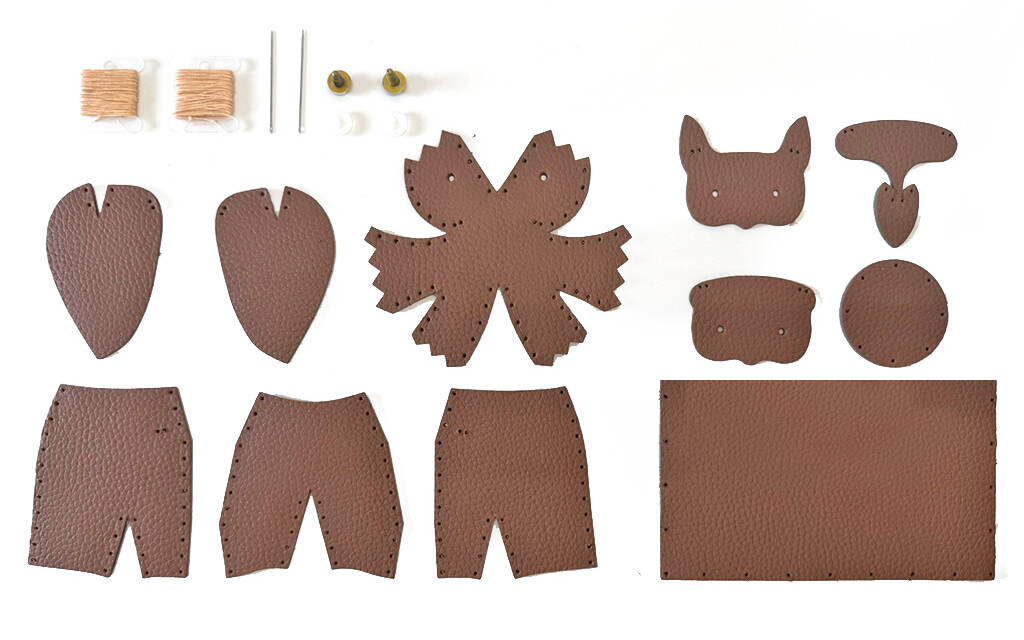
Leather did bring one serious problem of its own. You cannot snap it. Parts have to be sewn together, and sewing leather properly begins with punching stitch holes — evenly spaced, cleanly placed. Ask a beginner to do that and you have built a wall, not a doorway. It is precisely the kind of obstacle that stops a level-five hand at the entrance.
So the holes come pre-punched. Every part, every hole, already placed.
I thought carefully about whether this made me a hypocrite — whether I was bolting a safety guard onto my own chisel. I’ve concluded it didn’t, and the distinction matters enough to write down. A bad guard stands between you and the encounter: the blade never meets the wood, the dungeon comes with a walkthrough. A good one clears away the wrong obstacle so that the right encounter can happen. The hole placement was never the lesson. The stitching is the lesson — the tension, the rhythm, the pulling of a thread through leather several hundred times while your hands slowly figure out what evenness feels like.
Remove the wrong wall. Keep the right resistance. That is the entire trick, and I suspect it applies to considerably more than leather kits.
And here is where the hundred robots come back.
People tie shoelaces the same way in theory and differently in fact — tension, loop size, the little habits of fingers. Stitching is the same. Give a hundred people the same parts, the same holes, the same thread, and the stitches will pull with a hundred slightly different tensions, and the owls will lean a hundred slightly different ways. Same instructions. Same box. A hundred different owls.
Not one of them is wrong. Each one is a record of the hands that made it — including the places where those hands failed, unpicked the thread, and went back in.
The plastic robot assembles flawlessly and carries no trace of you. The owl is nothing but traces.
Somebody who builds one of our kits will, at some point during those evenings, do a seam badly. I know this the way you know the sun will rise. They will look at it, dislike it, undo it, and do it again. No blood. No scar. But the experience points are issued all the same — the old currency, back in circulation, at a desk lamp, in an evening.
Level five, when it goes to bed that night, is no longer exactly level five.
And the diploma, this time, you can put on a shelf. It has ears.
One more thing — because it’s the part I most wanted to build.
A finished kit is not actually finished. Undo the stitches, and the parts return to zero, unharmed, ready to be assembled all over again. The second time through, you might change the colors. Use a different thread for every seam. Cross the stitches over the holes the way some people lace their shoes — there are, it turns out, schools of thought about this. All of it is allowed. All of it is yours.
But notice what makes that freedom possible: you have been to the end once. The route is in your head now. The second climb comes with a bonus the first one didn’t have — composure — and composure, I’ve come to think, is what individuality is made of. Nobody improvises the first time through. The second time, the hands finally have room to say something.
In the language of those old games, this is New Game Plus. Starting over from the very beginning, carrying everything you earned.
A level-five maker finishes the first owl at level six, maybe seven. The second owl is what those levels are for.
That — more than the leather, more than the animal — is what I wanted this product to say.
Muneshige Tanigawa / Kyoto Makotoya
失敗という仕様
後編(全2回)
前回は、ひとつの決心で終わった。人がちゃんと失敗できて——それを感じて、そこから学べて——しかも血を流さずに済むキットを設計する、という決心だ。
最初の問いは素材だったが、正直に言えば、素材は自分で決まった。僕の会社は天然皮革を販売していて、革製品を作っている。コーヒーショップは、原則として、コーラを出さない。ただ、記録のために書き添えておくと、革はコネがなくても実力でこの仕事を勝ち取っていたと思う。手触りがいい。呆れるほど丈夫だ。曲げても、捻っても、畳んでも、「で、次は?」という顔で戻ってくる。
そして革には、他のすべてより重要な性質がひとつあった。名前をつけるまでに少しかかったけれど。
革は、赦すのだ。
プラモデルを組んだことのある人なら、「踏まれたパーツ」という固有の悲劇を知っている。あれはたいてい夜に、素足の下で起きる。順番はいつも同じだ。パキ、という音。痛み。持ち上げられる足。そして、謝罪の届かない場所で二つに割れて転がっている、小さな白い部品。プラスチックは形を完璧に保持し、恨みを永久に保持する。一度の過ちでパーツは終わり、ときにはキットごと終わる。
革のパーツは、踏まれても、革のパーツだ。捻れたら、捻り戻せばいい。縫い間違えたら、ほどいて、縫い直せる。そして素材は、受けた仕打ちの記憶を一切持ち越さない。革には何度でも失敗して落ちていい。革のほうは、毎回、まっさらからやり直すことに同意してくれる。
手が安全に経験値を稼ぐためのキットにとって、これはおまけの長所ではなかった。これが本体だった。失敗が何かを教えるためには、失敗が生き延びられるものでなくてはならない——パーツにとっても、人にとっても。
失敗ほど人に経験値を付与できる経験はない、と僕は長いこと信じてきたし、いまも信じている。ただ、そこには一本の線があって、作り手なら全員その位置を知っている。立ち直れる失敗は人を教えるが、立ち直れない失敗は「やめ方」しか教えない。絶望は、カリキュラムではないのだ。
だから設計指針は、正直に書くと、奇妙なものになった。失敗の余地を組み込むこと——ただし、失敗に床を張っておくこと。がんばりつづければ、きれいに仕上がる。努力が、良いフクロウに確実に換金される。それが、僕が差し出したい取引だった。
革は革で、ひとつ深刻な問題を持ち込んできた。スナップができないのだ。パーツは縫い合わせるしかなく、革をちゃんと縫うには、まず縫い穴を開けることから始まる——等間隔に、正確な位置に。初心者にそれを求めた瞬間、そこに建つのは扉ではなく壁だ。レベル5の手を入口で止める、まさにあの種類の障害物である。
だから、穴は最初から開けてある。全パーツ、全穴、配置済みで。
これで僕は偽善者になったのではないか——自分の彫刻刀に、自分で安全ガードを取り付けたのではないか——と、けっこう真剣に考えた。結論としては、違う。そしてこの区別は、書き残しておく価値がある。悪いガードは、人と出会いのあいだに立つ。刃は木に触れないまま終わり、ダンジョンには最初から攻略本がついてくる。良いガードは、間違った障害物を片付けて、正しい出会いが起きるようにする。穴の位置は、そもそも授業ではなかった。授業は縫うことのほうだ——糸の張り、リズム、革に糸を数百回くぐらせるうちに、手が「均一さ」の手触りをゆっくり理解していく、あの過程だ。
間違った壁を取り除く。正しい抵抗を残す。仕掛けはこれだけで、そしてこれは、革のキットよりずっと広い範囲に応用が効く気がしている。
そして、ここで百体のロボットが戻ってくる。
靴紐の結び方は、理論上は全員同じで、実際には全員違う。糸の張り、輪の大きさ、指の小さな癖。縫い目も同じだ。百人に同じパーツ、同じ穴、同じ糸を渡しても、縫い目は百通りの微妙に違う張りで引かれ、フクロウは百通りの微妙に違う傾き方をする。同じ説明書。同じ箱。百体の、違うフクロウ。
そのどれひとつとして、間違いではない。一体一体が、それを作った手の記録だ——その手が失敗して、糸をほどいて、もう一度入っていった場所も含めて。
プラスチックのロボットは完璧に組み上がり、あなたの痕跡をひとつも持たない。フクロウは、痕跡以外の何ものでもない。
うちのキットを組む人は、あの何日かの夜のどこかで、必ず一箇所、縫い目をしくじる。太陽が昇ることを知っているのと同じ確度で、僕はそれを知っている。その人はそれを眺めて、気に入らなくて、ほどいて、もう一度縫う。血は出ない。傷痕も残らない。それでも経験値はきちんと発行される——あの古い通貨が、デスクランプの下、ひと晩の中で、再び流通しはじめる。
その夜眠りにつくレベル5は、もう正確にはレベル5ではない。
そして今回の学位は、棚に飾れる。耳つきだ。
もうひとつだけ。これが、いちばん作りたかった部分だから。
完成したキットは、実は完成していない。縫い合わせた糸をほどけば、パーツは無傷のままゼロに戻って、もう一度組み立てられるのを待っている。二度目は、色を変えてみてもいい。縫う箇所ごとに糸の色を変えてもいい。靴紐を靴に通すやり方にいくつも流派があるように、穴を交差させながら縫うのも、もちろんありだ。全部、許されている。全部、あなたのものだ。
ただ、その自由が何によって可能になっているかに、注目してほしい。あなたは一度、最後まで行ったことがある。ゴールまでの道順が、もう頭の中に入っている。二度目の登り道には、一度目にはなかったボーナスがつく——余裕だ。そして個性というものは、思うに、余裕からできている。初見で即興をやれる人はいない。二度目になって初めて、手には、何かを言うための余白が生まれる。
あの古いゲームたちの言葉で言えば、これは「強くてニューゲーム」だ。稼いだものを全部持ったまま、いちばん最初から、もう一度始めること。
レベル5で始めた作り手は、一体目のフクロウを、レベル6か7で完成させる。二体目のフクロウは、そのレベルの使い道だ。
それが——革よりも、動物よりも——この商品に言わせたかったことだ。
Muneshige Tanigawa / Kyoto Makotoya