
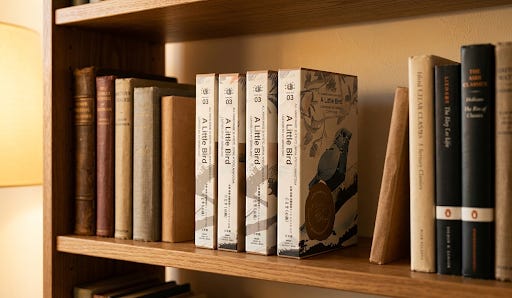
The box was designed alongside the first kit.
Not afterward, as packaging typically is — added once the object is settled. From the beginning, they were a single problem.
The condition I gave myself was simple: it had to fit on a bookshelf. With a spine. The kind of spine that shows its title when everything else in the row is also showing its spine.
I had in mind the image of a hardcover book.
This decision came from thinking about when someone would actually open it.
Not necessarily when they bought it. The moment of buying and the moment of making are rarely the same evening. A kit like this asks for a particular kind of readiness — a free evening, a willingness to sit with something slow. That readiness doesn’t arrive on schedule.
What I didn’t want was for that evening to come, and for the kit to be unfindable. Somewhere in a drawer. Behind something else. Lost in the way things get lost when they don’t have a proper place.
A book has a place. A bookshelf is a commitment. Things that live on bookshelves are things you intend to return to.
The spine holds only two things: the title and the series number. No illustration. The space is too narrow for decoration without becoming cluttered — clarity was more useful than presence.
The surface is craft paper in color and texture. Slightly rough to the touch. Among actual books, it stands apart. This was intentional: I didn’t want it to hide among books, I wanted it findable. A different texture in a familiar row.
The craft paper also says something about what’s inside. This is not a book. It is made of something. So is the thing inside it.
Each box’s front face holds its own world.
The center is the completed model — photographed, not illustrated. What you will make, already made. But the environment it inhabits is drawn: line work, open space, something closer to the background of a manga panel than to product photography.
The illustration breathes. It leaves room for the model to occupy the attention.
Each animal received its own world. The owls are in a forest. The goldfish floats in white. The little bird sits on a watercolor branch. The ladybird rests on an ink-drawn flower. The pig stands in a pastoral meadow.
These are not accurate natural habitats, exactly. They are closer to how a child might imagine where that animal lives. The kind of world the animal deserves, rather than the one it actually occupies.
When I think about how a bookstore would display these, I think about all the ways a bookstore displays books: spines out along a shelf, faces forward in a stand, flat in a stack on a table. The kit was designed to work in all of those arrangements.
A buyer doesn’t need a special fixture. A bookshelf is enough. The series lines up the way a series of books lines up — numbered, consistent, each one its own thing within a recognizable whole.
A bookshelf is a library of intentions.
The books you haven’t read yet. The ones you’re halfway through. The ones you finished and kept anyway. Past and future and ongoing, side by side. The shelf holds them equally.
The kit was designed to live in that same company. On a shelf between books, waiting for the evening that belongs to it.
And if that evening starts but doesn’t finish — if the work stops halfway, and the pieces go back into the box, and the box returns to the shelf — that is allowed. The box was designed for that too.
The kit also reads differently depending on who encounters it.
Someone who grew up surrounded by things made by skilled hands might see an unfinished object — something that still requires work. The assumption beneath that reading: good things are made by people who know how to make them.
Someone who bakes bread on weekends, or builds models on Saturday afternoons, might see something else entirely: not a task, but an invitation. The same box. Different things visible inside it.
What I’ve noticed is that the people who respond most readily aren’t necessarily more skilled, or more patient. They simply come from a context where doing something yourself is understood as part of the value — not an obstacle to it.
A bookshelf is also a kind of self-portrait.
When you visit someone’s home and look at their shelves, you learn something about them — what subjects draw them, how they organize the things they keep, what they intend to return to. The arrangement alone tells you something. A visible record of where a person’s attention has been, and where it wants to go.
If a leather model kit sits among those books, it says something too. That this person makes things with their hands, or wants to. That they set aside time for something unhurried. That they carry an intention they haven’t acted on yet — or one they’ve already started.
As the person who made the kit, I find that thought quietly beautiful.
The box contains leather parts, thread, and a set of instructions. It also contains, in a less obvious way, the afternoon in which those parts become something. That time is part of what you’re taking home.
Muneshige Tanigawa / Kyoto Makotoya
箱はキットと同時に設計した。
通常の梱包のように、後から付け加えるものではなかった。最初から、ひとつの問題として。
自分に課した条件はシンプルだった。本棚に収まること。背表紙があること。他の本と並んで棚に立った時に、自分のタイトルを見せられること。
ハードカバーの本を、イメージとして持っていた。
この決断は、「いつ開封されるか」を考えることから来ている。
購入した日とは限らない。買った瞬間と、作り始める夜は、たいてい別だ。このようなキットは、ある種の準備が整った時に開かれる。空いた夜。時間をかけて何かに向き合える状態。その準備は、決まった日に来るわけではない。
その夜が来た時に、キットが見つからないという状況は避けたかった。引き出しの中に。何かの後ろに。定位置を持たないものが迷子になるように。
本には定位置がある。本棚は、戻る意志の表れだ。本棚に置かれるものは、いつかまた向き合おうと思われているものだ。
背表紙に書かれているのは、タイトルとシリーズ番号だけ。イラストは入れない。狭い面積に装飾を加えると、ごちゃごちゃする。視認性の方が、存在感より役に立つ。
素材はクラフトペーパーのような色と質感。わずかにざらついた手触り。本の間に並べると、少し目立つ。それは意図的なことだ。本に紛れてほしいのではなく、見つけてほしいから。
クラフトペーパーの手触りは、中身についても何かを伝えている。これは本ではない。何かで出来ている。中のものも、そうだ。
各キットの表紙は、それぞれの世界を持っている。
中心にあるのは完成した模型の写真。これから作るものが、すでに完成した形で写っている。でも、その模型が置かれた環境はイラストで描かれている。線画で、余白が多く、漫画の背景のような空気感。
イラストが呼吸している。模型が注目の中心になるための余白。
それぞれの動物に、それぞれの世界を与えた。フクロウは森。金魚は白い空間。小鳥は水彩の枝。てんとうむしは墨絵の花。豚は草原。
正確な生息地ではない。どちらかといえば、子どもがその動物の住む場所を想像した時に出てくる風景に近い。その動物が実際にいる場所ではなく、いるべき世界。
書店でこのシリーズがどう並ぶかを考える時、本が取り得るすべての陳列方法を思い浮かべる。背表紙を見せて棚に並べる。正面を向けてスタンドに立てる。テーブルに平積みにする。そのどれでも機能するように設計した。
特別な什器は要らない。本棚があれば十分。シリーズは、本のシリーズが並ぶように並ぶ。番号順に、統一感を持ちながら、それぞれが独立している。
本棚は、意志の図書館だ。
まだ読んでいない本。読みかけの本。読み終えて手元に残した本。過去と未来と途中が、一緒に並んでいる。本棚はそれらを等しく受け取る。
革模型キットも、その棚の中で暮らすように設計した。本の間で、その夜を待つ。
その夜が途中で終わったとしても、パーツを箱に戻して、本棚に返せばいい。それも、想定している。
このキットは、出会う人によって、違うものに見える。
職人の手で作られたものに囲まれて育った人には、未完成のもの——まだ手が必要なもの——として映るかもしれない。その読み方の背景には、ある前提がある。良いものは、作り方を知っている人が作る。
週末にパンを焼いたり、土曜の午後にテーブルでモデルを組み立てたりしてきた人には、まったく違うものが見える。作業ではなく、招待状として。同じ箱なのに、見えているものが違う。
気づいたのは、すんなり手を伸ばす人が、特別に器用だったり辛抱強かったりするわけではないということだ。ただ、自分でやることが価値の一部だと理解している文脈の中にいる。障害としてではなく。
本棚はまた、その人の自画像でもあると思う。
友人の部屋にお邪魔して棚を眺めると、その人のことが少し分かる。どんなジャンルに引きつけられているか、手元に残したものをどのように並べているか、どこへ戻ろうとしているか。並びを眺めるだけで、その人の注意がどこにあったか、どこへ向かおうとしているかが、少しずつ見えてくる。
そこに、革模型キットが収まっていたら、それもまた何かを伝える。この人は手を動かして何かを作る。あるいは、そうしたいと思っている。急がない時間を、どこかに取っておいている。まだ実行していないか、すでに始めているかは分からないが、その意志を持ち続けている。
制作者として、それを想像するとき、静かに嬉しいと思う。
箱の中には、革のパーツと糸と、組み立ての手順が入っている。それ以外にも、もう少し見えにくいものが入っている。パーツが何かになる、その午後だ。持ち帰るのは、それも含めてだと思う。
Muneshige Tanigawa / Kyoto Makotoya