
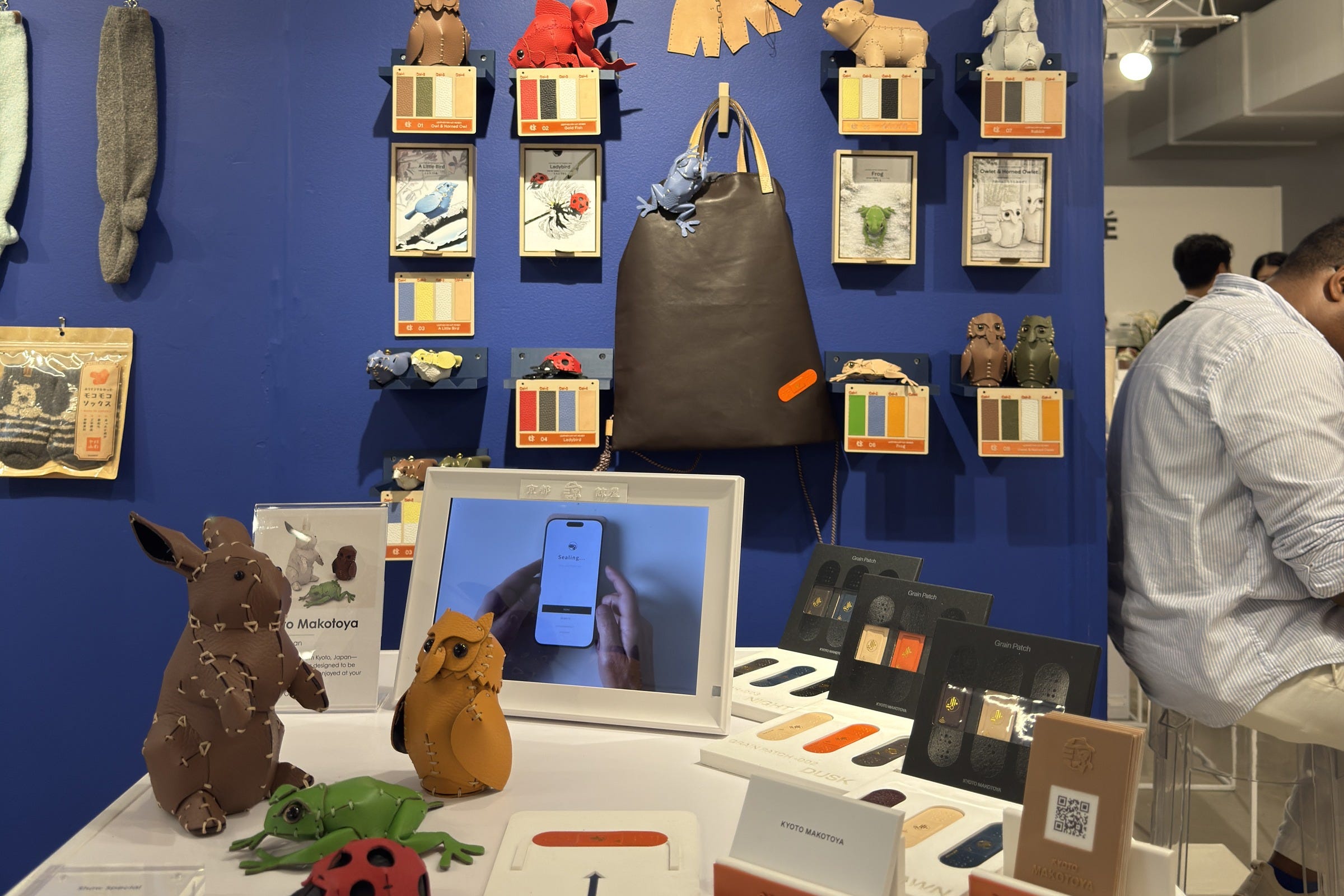
In February, I stood in a booth in a building called Starrett-Lehigh, on the west edge of Manhattan, and sold leather animals. In August I went back. Same building, same floor, same corner — the same room, for all practical purposes.
Only one thing had changed. This time, one of the objects on the table had a name.
On the morning the show opened, I stood in the finished booth and took a quiet inventory of my worries.
The leather kits I wasn’t worried about. I had watched people meet them in February, and I knew more or less what would happen: they would pick up the owl, turn it over, smile at something. That part of the future was already on file.
Grain Patch had no file. Nobody outside my workroom had ever stood in front of one. Whatever was going to happen would happen here, in this room, over three days, and there was no way to look it up in advance.
The booth itself was bigger this time, which sounds like good news and mostly is, except that a bigger space is also a bigger sentence to finish. I had assembled the layout dozens of times in my head before flying. And here is the strange part: the real booth came out almost exactly like the one in my head.
Life, as a rule, pays no respect to the blueprints in your head. On moving day, the furniture never fits the way the floor plan promised it would. My hair has never once left a barbershop looking like the photograph I pointed at. So when the real booth assembled itself almost exactly like the imaginary one, my first feeling wasn’t joy. It was a thin layer of suspicion. When the world nods quietly at your plans, it is usually balancing the books somewhere else.
The doors opened, the aisles filled, and people began to hold their phones over small pieces of leather.
I had prepared a careful explanation of the chip inside — what it was, how it worked, why it needed no battery. I barely used it. Everyone already knew. Buyers, shop owners, people who looked like they had wandered in from a different century — they all nodded along at the technical part as if I were explaining how a doorbell works. I had studied hard for precisely the questions nobody asked. The explanation spent three days in my bag, like a folding umbrella on a trip where it never rains. You’re supposed to be glad about that, I know. Somehow it doesn’t work that way.
So the structure of the thing crossed the room in about ten seconds, exactly as I had hoped.
The surprise happened too. People’s eyebrows went up. They turned the patch over, held their phone over it again, passed it to whoever they were with. That was the reaction I had flown eleven thousand kilometers to see.
But here is the honest part. What raised those eyebrows was almost never the thing I care most about. It was the practical tricks — that the leather could hold your social profile, your website, your shop’s page. Useful, immediate, easy to explain over the noise of a trade show. The words themselves — the idea of choosing a few of them and wearing them — stood politely at the back of their own stage, while the supporting cast took the applause.
I know this phenomenon well, actually — from the other side of the stage. Every year, in that famous glass building in California, somebody presents the new iPhone with tremendous eloquence. And in all these years, the headline features have almost never been the reason I upgraded. What gets me is always the quiet one: some small capability mentioned around the second-to-last line of the spec sheet, in a font that seems mildly embarrassed to be there. That one line has moved more of my money than any keynote ever has.
For three days at the booth, I was the keynote. And my visitors, every one of them, were me.
I don’t say this bitterly. Every one of those functions begins with words; the door people walked in through happened not to be the front one. But I noted it, each time, the way you note water coming in somewhere low in a boat.
Meanwhile, on the wall behind me, a different misunderstanding was quietly running.
For the kits, I had printed frames and mounted the boxes inside them — all the series, in rows, with their color cards. The effect was clean. Gallery-clean. Which turned out to be the problem: people looked at the wall and saw framed graphic art. They assumed we were a shop selling finished leather figures, walked the booth under that assumption, and left with it intact.
When a conversation did start, and I explained that every box on that wall was a kit — needle, thread, parts, something you make yourself over a few evenings — the answer came back so often it started to feel like a chorus: “Oh — that’s even better.”
It’s a fine phrase, that’s even better. I heard it dozens of times in three days. Though it is also, if you think about it, a phrase that only exists when something failed to come across the first time. A perfectly designed wall would never hear it.
My boxes were mistaken for art. As failures go, this is one of the more flattering kinds available. And it was New York, after all — a city where a urinal has been fine art for a hundred years now. Measured against that record, one well-made box slipping into the wrong category barely qualifies as news.
Still. A failure is a failure.
It took me until the second day to understand what the wall was actually teaching.
In a museum shop, a person picks things up. They have time. They read the small text, open the lid, put it back, come back to it. Given that speed, the boxes would have introduced themselves correctly.
A buyer at a trade show moves at a different speed entirely. They have two hundred booths and one afternoon. They read a wall in a second and a half, sort it into a category, and keep walking. It’s the speed of eyes watching the conveyor belt at a sushi restaurant: every plate gets seen, but the hand only goes out for the one that checks all the boxes. At that speed, a well-framed box is art, a finished owl is inventory, and nothing on my table has time to explain itself.
Same wall. Same boxes. Same light. The room changes according to the speed of the eyes moving through it.
I make a product whose whole argument is that a few words deserve a slower speed. It had not occurred to me that the argument applied to my own booth. The room was ahead of me on this one.
Three days is a long time to stand in one spot and watch your own work being read at other people’s speeds. But the room wasn’t finished with me.
Out of all those hurried footsteps, two visitors are still walking around in my head — a man who stopped for barely a minute and left me homework measured in years, and another who did something no visitor had ever done to me before.
That part, next time.
Muneshige Tanigawa / Kyoto Makotoya
同じ空間
2月、僕はマンハッタンの西の端、Starrett-Lehighという建物のブースに立って、革の動物たちを売っていた。8月、またそこへ戻った。同じ建物、同じフロア、同じ角——実質的に、同じ空間だ。
変わったことはひとつだけ。今回は、机の上の物体のひとつに、名前があった。
初日の朝、設営の終わったブースに立って、心配ごとの棚卸しを静かにやった。
革模型キットの心配はしていなかった。2月に、人がキットと出会う場面を何度も見ていたからだ。何が起きるかは、だいたい分かっていた。フクロウを手に取り、ひっくり返し、何かに微笑む。未来のその部分は、もうファイルに綴じてあった。
Grain Patchにはファイルがなかった。僕の作業部屋の外で、これの前に立った人間はまだ一人もいない。何が起きるにせよ、それはこの部屋で、これからの三日間で起きる。事前に調べておく方法は、どこにもない。
ブースは前回より広くなっていた。良い知らせに聞こえるし、だいたいは良い知らせなのだが、広い空間というのは、書き終えなければならない長い文章でもある。飛行機に乗る前、頭の中でレイアウトを何十回も組んだ。そして奇妙なことに、実物のブースは、頭の中のものとほとんど同じに仕上がった。
人生というのは、だいたいにおいて、頭の中の設計図に敬意を払わないものだ。引っ越しの日、家具は間取り図が約束した通りには収まらない。美容院を出た僕の前髪が、指差した写真の通りだったことも、一度もない。だから実物のブースが想像とほぼ同じに組み上がったとき、最初に来たのは喜びではなかった。薄い一枚の警戒だった。世界がこちらの計画に黙って頷くときは、たいてい、どこか別の場所で帳尻を合わせている。
扉が開き、通路が埋まり、人々が小さな革の上にスマホをかざしはじめた。
中のチップについては、丁寧な説明を用意していった。それが何で、どう働いて、なぜ電池が要らないのか。ほとんど出番はなかった。みんな、もう知っていたのだ。バイヤーも、店主も、別の世紀から迷い込んできたような人も——技術の部分になると、玄関チャイムの仕組みを聞かされているような顔で頷いた。誰にも訊かれない問いのために、僕は入念に予習していたわけだ。用意した説明は、雨の降らない旅に持っていった折りたたみ傘のように、三日間、鞄の中で眠っていた。喜ぶべきことなのは、分かっている。ただ、人間はどうも、そういうふうには出来ていない。
つまり、この物体の構造は、望んだ通り、10秒ほどで部屋を渡った。
驚きも、ちゃんと起きた。眉が上がる。パッチを裏返す。もう一度かざす。連れの人に手渡す。それは、一万一千キロを飛んで見に来た反応そのものだった。
ただ、正直な部分を書く。眉を上げさせたものは、僕がいちばん大事にしているものでは、ほとんどなかった。刺さったのは実用的な芸のほうだった——革にSNSのプロフィールを持たせられること、ウェブサイトを、店のページを持たせられること。便利で、即座で、展示会の騒音越しでも説明しやすい。言葉そのもの——数語を選んで、纏うという考えは、自分の舞台の奥に礼儀正しく立っていて、拍手は脇役たちが受け取っていた。
実を言えば、この現象を、僕は反対側の席からよく知っている。毎年、カリフォルニアのあの有名なガラスの建物で、誰かが新しいiPhoneを見事な雄弁でプレゼンする。そして正直なところ、あの「推しポイント」が僕に刺さったことは、これまでほとんどない。僕を機種変更させてきたのは、いつも地味なほうだ——仕様説明の、最後から二行目あたりに、少し気恥ずかしそうな小ささで書かれている機能。あの一行は、どのキーノートよりも多くの僕のお金を動かしてきた。
ブースでの三日間、僕はキーノートの側だった。そして来場者たちは、全員、僕だった。
苦々しく言っているのではない。どの機能も、発端は言葉だ。人々が入ってきた扉が、たまたま正面玄関ではなかった、というだけのこと。ただ僕はそれを、そのたびに記録した。船の低いところに水が入ってくるのに気づいたときのやり方で。
その間、僕の背中側の壁では、別の誤解が静かに進行していた。
キットのために、フレームを出力して、化粧箱をそこにはめて展示した。全シリーズ、色カード付きで、整然と。仕上がりは綺麗だった。ギャラリーみたいに綺麗だった。それが問題だったと、あとで分かる。人々は壁を見て、額装されたグラフィックアートだと思った。我々を、完成品の革のフィギュアを売る店だと思い、その前提のままブースを歩き、その前提のまま去っていった。
会話が始まって、あの壁の箱は全部キットなんです——針と糸とパーツが入っていて、何日かの夜をかけて自分で作るものなんです——と伝えると、あまりに同じ答えが返ってくるので、途中から合唱のように聞こえはじめた。「Oh——that’s even better」。
いい言葉だと思う、that’s even better。三日間で何十回も聞いた。ただ、考えてみればこれは、最初に伝わりそこねたときにだけ発生する言葉でもある。完璧に設計された壁は、この言葉を一度も聞かない。
僕の箱は、アートと間違えられた。失敗の中では、かなり嬉しい部類の失敗だ。それに、ここはニューヨークだ——便器が美術品になってから、そろそろ百年になる街だ。その実績に照らせば、よく出来た化粧箱がひとつ隣のカテゴリーに滑り込んだくらい、ニュースにもならない。
それでも。失敗は失敗だ。
壁が本当は何を教えていたのか、理解するのに二日目までかかった。
ミュージアムショップでは、人は物を手に取る。時間があるのだ。小さな文字を読み、蓋を開け、棚に戻し、また戻ってくる。あの速度なら、箱は正しく自己紹介できていたはずだ。
展示会のバイヤーは、まったく別の速度で動く。二百のブースと、ひとつの午後。壁を一秒半で読み、カテゴリーに仕分けて、歩きつづける。あれは、回転寿司のレーンを眺める目の速度だ。皿は全部見えている。でも、手が伸びるのは、条件の揃った一皿だけだ。あの速度では、綺麗に額装された箱はアートで、完成したフクロウは在庫で、僕の机の上の何ものにも、自己紹介の時間は与えられない。
同じ壁。同じ箱。同じ照明。部屋は、そこを通り過ぎる目の速度によって、別のものになる。
僕は、数語の言葉にはもっと遅い速度がふさわしい、というのが主張のすべてであるような商品を作っている。その主張が自分のブースにも適用されるとは、考えていなかった。ここについては、部屋のほうが僕より先を歩いていた。
三日間というのは、一箇所に立って、自分の仕事が他人の速度で読まれていくのを眺めるには、長い時間だ。でも、部屋はまだ僕を解放していなかった。
あの急ぎ足の群れの中から、二人の来場者が、いまも頭の中を歩きまわっている。一分足らずしか立ち止まらなかったのに、年単位の宿題を置いていった男。そして、それまでどの来場者もしたことのないことを、僕にした男。
その話は、次回。
Muneshige Tanigawa / Kyoto Makotoya